Project Tracking in Mechanical and Plant Engineering: Tools, Methods, and Best Practices
Project tracking in mechanical and plant engineering: tools, methods, and structures that reliably safeguard schedules, budget, and quality.


In mechanical and plant engineering, projects are rarely linear. Design, procurement, manufacturing, assembly, and commissioning are all interlinked, often across multiple locations and suppliers. Even a small delay in the delivery of a key component can push the final deadline back by weeks. Professional project tracking is therefore not an administrative chore, but the central control mechanism that determines schedule reliability, margin, and customer satisfaction. This article explains what project tracking means in mechanical engineering, why it is harder here than in many other industries, what effective project tracking has to cover, and how that plays out in practice.
What Is Project Tracking in Mechanical and Plant Engineering?
Project tracking — also called project monitoring or project controlling — refers to the continuous monitoring and control of a project across all phases. The goal is to identify deviations between plan and actual status early and intervene before schedules, budget, or quality are put at risk. In mechanical and plant engineering, project tracking has three distinctive characteristics: several trades running in parallel with their own supply chains, contractually secured delivery dates with penalty clauses for delay, and a high exposure to disruption from material shortages or late specification changes. The following sections cover each of these in detail. Consistent project tracking connects these dimensions in a single control model that shows everyone involved the same version of the truth — from the project manager through the individual trades to executive management.
Why Project Tracking Is Harder in Mechanical Engineering Than Elsewhere
Anyone responsible for industrial projects knows the recurring pitfalls. Three characteristics make project tracking in mechanical and plant engineering more demanding than in many other industries.
Complexity from Parallel Trades and Long Lead Times
Mechanical engineering projects combine mechanical, electrical, hydraulic, and software components, often with noticeable lead times for key parts such as drives, controls, or custom components. Each trade has its own suppliers, its own lead times, and its own inspection steps. Synchronization only works if everyone feeds their status into a single, central view — whether that is a design maturity level, a delivery date in procurement, or a commissioning status in assembly. Without that central view, a delay in one place stays invisible until it hits the final deadline.
Tight Schedules, Contract Penalties, and External Trades
In plant engineering, delivery dates are usually secured by contract, often with penalty clauses for delays. That obligation extends beyond the general contractor: subcontractors, assembly partners, and suppliers frequently work to their own schedules that do not automatically stay in sync with the master project plan. Anyone who identifies delays too late loses the ability to course-correct. Project tracking with short reporting cycles — weekly, ideally updated daily for critical paths — is therefore not a nice-to-have, but an economic necessity.
Risks from Material Shortages and Specification Changes
Supply shortages for electronic components, changed customer specifications, or regulatory requirements can upend the project plan at any time. Effective project tracking therefore maintains an ongoing risk register, assigns a probability and impact to each risk, and defines concrete countermeasures along with clear ownership.

Tools and Methods for Effective Project Tracking
The toolbox for project tracking in mechanical and plant engineering includes classic methods as well as modern platform solutions. What matters is not the individual tool, but a consistent, end-to-end data foundation across all trades. Four elements belong in it:
- A central project management platform: Plain office tools like Excel and Outlook quickly reach their limits when hundreds of work packages, dozens of stakeholders, and multiple projects need to be managed at once. Specialized platforms such as Linetrack map tasks, schedules, responsibilities, and status in a single system and enable role-based views — from a project manager's cockpit to detailed views for individual trades.
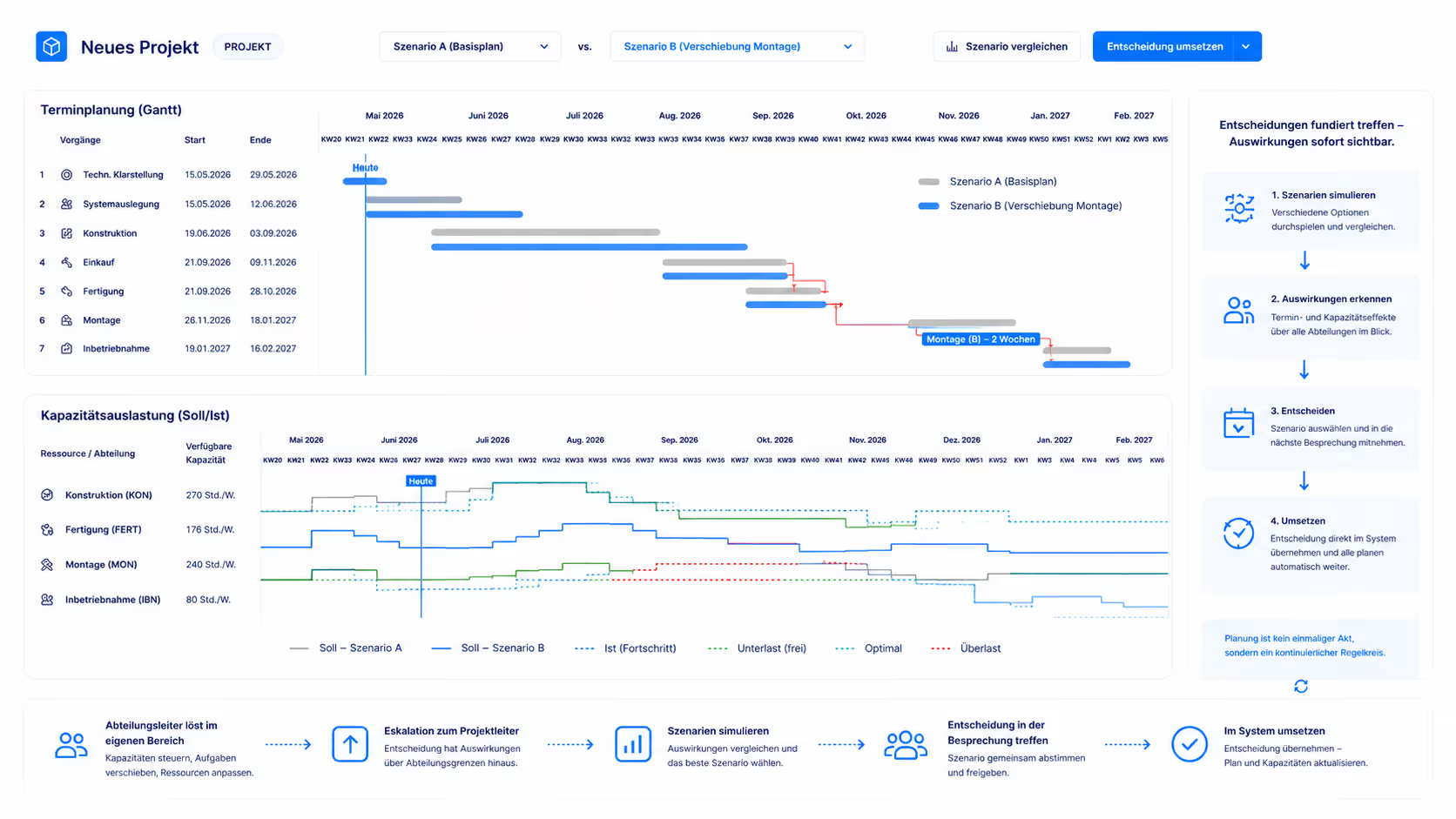
- Gantt charts linked to real-time status: The Gantt chart remains a central instrument: it visualizes activities, dependencies, and milestones over time and makes the critical path visible. However, a Gantt chart only becomes truly useful once it is linked to real-time status — otherwise it merely documents the wishful state from the project's kickoff.
- Kanban boards at the operational level: At the task level, Kanban boards have proven effective for tracking the status of individual work steps transparently — from "planned" through "in progress" to "accepted." In mechanical engineering, Kanban is particularly well suited to manufacturing stages where many smaller tasks are processed sequentially.
- Lean and just-in-time principles: Lean methods reduce waste in project execution, for example through standardized workflows, pull principles in material provisioning, and short response cycles. Instead of maintaining plans for months that do not hold up anyway, teams increasingly shift to rolling, short-term detailed planning combined with a medium- to long-term framework view.
Common Mistakes and What They Cost in Practice
Three sources of error occur particularly often in mechanical and plant engineering projects — and can largely be eliminated with clear structures.
- Poor cross-departmental communication: When design, purchasing, and assembly work in separate tools and only exchange status updates by email, information gets lost. A central platform with clear responsibilities and automatic notifications systematically reduces this friction.
- Unclear objectives and acceptance criteria: If project goals are not defined in measurable terms, progress cannot be assessed objectively. Clear acceptance criteria — functional, technical, and contractual — belong in the project initiation phase. They are also the foundation for a clean final acceptance.
- Reactive rather than proactive risk management: In many projects, risks are only documented once they have already materialized. Proactive risk management identifies risks during the planning phase, assesses them, and plans countermeasures — before they become operational issues. This shifts control from reactive to proactive.
Anyone running multiple projects in parallel would do well to combine project tracking with portfolio-wide multi-project management, so that conflicts between projects become visible early on.
These failure modes show up in observable patterns. Empirical findings from industry and research support the economic value of professional project tracking:
| Area | Observation in Industry |
|---|---|
| Schedule reliability | Projects with continuous tracking regularly show schedule reliability well above the industry average, because deviations surface early enough to still correct course. |
| Budget variance | Deviations identified early can usually be corrected with a fraction of the effort required for late-stage damage control. |
| Response time | With real-time status, response time to disruptions drops from days to hours — a decisive advantage for delivery dates tied to contract penalties. |
| Knowledge transfer | Projects with structured documentation provide the basis for reliable effort estimates on future projects — and reduce dependence on individual experiential knowledge. |
The exact figures vary considerably depending on the industry, project type, and the maturity of the tools used. What matters is the pattern: visibility correlates with controllability, and controllability correlates with project success.
Conclusion: Visibility Is the Most Important Lever
Project tracking in mechanical and plant engineering succeeds when three conditions are met: a central data foundation for everyone involved, short reporting cycles with real-time status, and actively managed risk management. Tools alone are not enough — what matters is that the platform is integrated into the daily work of the trades and project teams rather than perceived as extra overhead. Companies that get this right gain not only schedule reliability, but also reliable data for future effort estimates and dependable risk management.
What that looks like when a machine builder puts it in place is set out in the Krüger & Salecker case study: the forming-machine manufacturer from Bad Schwartau tracks and manages its project data in one place and sees the status of every project in the same view.
FAQ
Frequently Asked Questions About Project Tracking
Bring Projects Safely to Completion — with Linetrack
See in a 30-minute live demo how Linetrack brings project tracking in mechanical and plant engineering onto a single central platform: real-time status, multi-project view, risk tracking, and ERP integration, all in one system.