Use case
Integrating suppliers
into projects
- A dedicated area for the supplier
- Automatic email invitation
- Collaboration free of charge for suppliers

In short
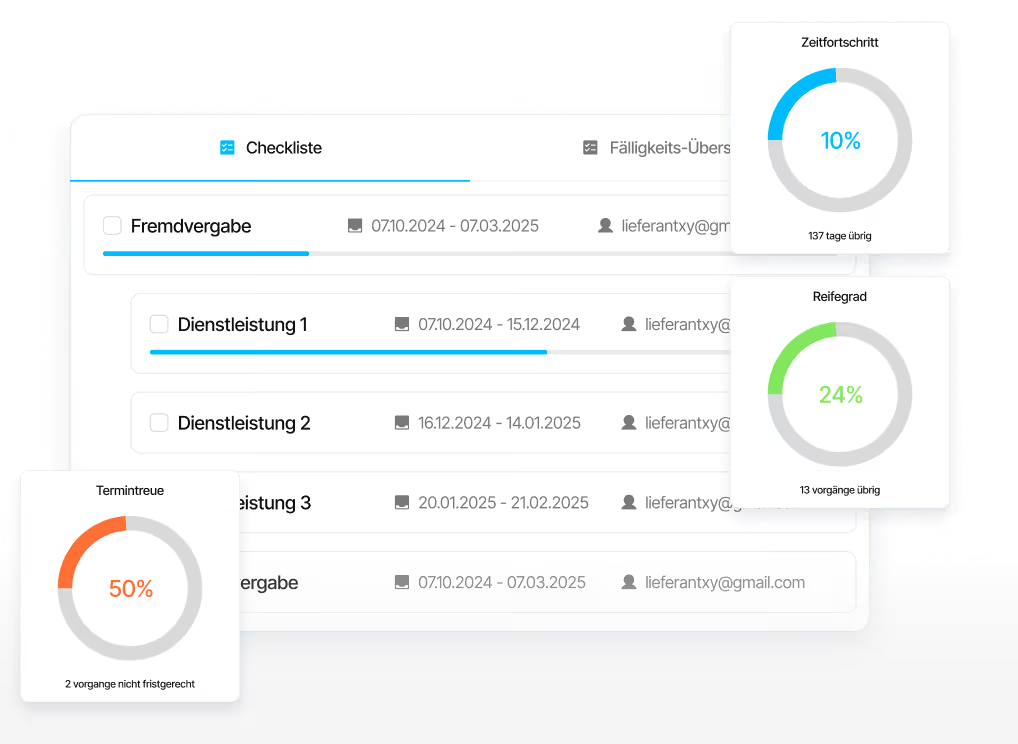
In Linetrack, integrating suppliers into projects means this: for a subcontract that genuinely matters to the schedule, an external service is created. That is the area the supplier works in – they see their own requirements, dates, and files, not the overall plan. The invitation goes out automatically by email, collaboration is free of charge for them, and the system itself reminds them when a report is due. What is not mapped is every purchased part: that stays in the ERP.





4000+
completed
industrial projects
1512
projects managed
in parallel
56%
of customers with a live
interface within 6 months
10
working days from
kick-off to go-live
All figures on this page come from a full survey of every productive Linetrack implementation, as of August 2026.
Challenges
Why the supplier stays a blank spot
in the schedule
In most industrial companies the subcontract is a task with a date that somebody maintains by email. Four consequences named repeatedly in onboarding conversations (multiple answers possible).
The external service is a bar with nothing behind it
The plan says “Subcontract welded assembly” with a start and end date. Whether the supplier has started, whether approvals are missing, whether the date still holds – none of that is in the plan. The bar reflects the commitment from the purchase order, not the state of the work.


Chasing dates instead of planning them
The project manager learns the status by chasing it on the phone. 59% of Linetrack customers explicitly named manual status requests as a reason for adopting the system. Every request ties up two people, and the answer is a snapshot that can already be out of date the next day. Across twenty external services and several projects, that becomes a job of its own.
The supplier list lives next to the plan
Dates, contacts, and commitments sit in a purchasing spreadsheet while the schedule sits in another tool. Of more than 400 planning tools replaced at Linetrack customers, the majority were spreadsheets of exactly this kind. Two versions of the truth side by side, reconciled reliably by nobody.
Delay only becomes visible in assembly
If a partner delivers two weeks late, assembly notices first – not the schedule. By the time the shift reaches the plan, downstream tasks are scheduled wrongly and internal capacity is blocked for a period in which nobody can work.
Definition
What is supplier integration in project management?
Supplier integration in project management means running schedule-relevant subcontracted work as tasks of its own in the project plan and letting the external partner work on it themselves: with their own access, assigned requirements, and reports that land directly in the plan. It replaces email coordination alongside the plan with documented date and status data created in the same system the plan lives in. The features available for this are shown on the product page supplier access.
This needs to be distinguished from supplier management as the umbrella term, which also covers selection, qualification, evaluation, and the contractual relationship. This page is only about coordinating dates and tasks inside a running project – in machinery and plant engineering, precisely the part a promised delivery date actually depends on. What is explicitly not meant is a complete picture of procurement: purchased parts and order processing stay in the ERP, and only the services whose progress moves the date go into the project plan.
The decisive point
Chasing dates stops when the supplier reports for themselves
A subcontract task in the schedule carries exactly one piece of information: when the supplier is supposed to be finished. Everything that decides whether that date holds lives in inboxes – the missing drawing approval, the shifted material date, the production manager's holiday at the supplier. The plan keeps a commitment alive until somebody contradicts it.
Supplier integration therefore does not mean knowing more about the supplier; it means letting them write into the plan. Only when the report is created where the planning happens does the schedule become a statement about reality again rather than about a purchase order.
And the prompt no longer comes from the project manager. Linetrack reminds the supplier automatically by email when a report is due; the link takes them straight into their own area, where they enter what has changed. With a handful of partners that saves a few phone calls. Across fifty external services and several parallel projects, it replaces a piece of work that used to come round every week – and how the subcontracted share plays out across a whole portfolio is covered on the multi-project management overview page.
For that to hold, the barrier on the other side has to stay low. Access costs the supplier nothing, they set their own password from the invitation email, and a two-minute video in their area explains what is expected of them. No rollout at the partner, no training course, no project before the project – they are able to work on the day the invitation goes out.
The difference shows at the first deviation. When the supplier reports a two-week delay in the system, it is not only their own task that moves: assembly, commissioning, and acceptance hang off the same dependency logic as internal tasks, and the capacity reserved for them comes up for rescheduling in the same moment. An internal plan with a blank spot at every subcontract becomes a project plan in which external and internal work are equally current.

How it works
From subcontract to report in the overall plan
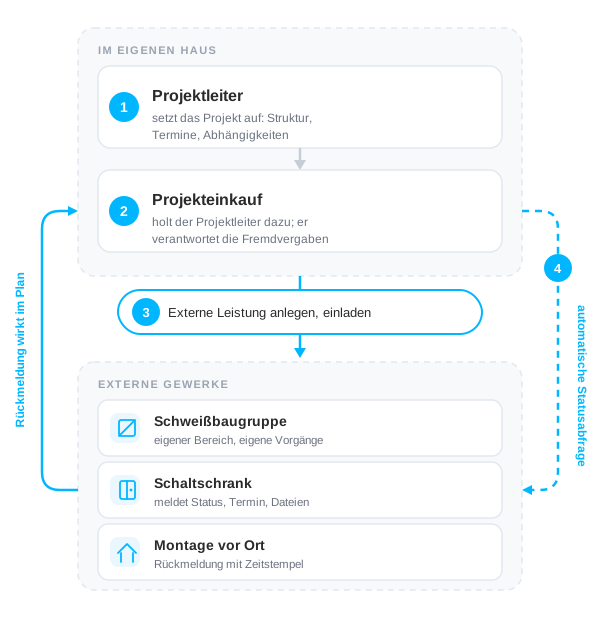
Working with a supplier runs through five steps – and it starts internally, not with an invitation. Only once the plan stands in your own house is it clear which subcontract needs an area of its own. The features behind it are described on the supplier access product page; this page is about how it plays out in the project.
The last step is the decisive one. A supplier portal that collects reports without them changing the schedule only moves the manual work – from a phone call into yet another tool.
How a reported deviation then feeds into scheduling and capacity planning is described on that page.
Rights and security
What the supplier sees – and what they don't
The most common objection to supplier integration is not about dates but about access: anyone letting an external party into the project plan has to control precisely what that party sees. Competitors sit in the same supply chain, and cost calculations belong to nobody outside the company.
The supplier sees only the external service assigned to them – for them, that area is the project: their requirements, their dates, their files and comments. Not visible are the overall schedule, the project portfolio, other suppliers' tasks, internal workload and capacity data, and every cost calculation. The access is a role in the project, not a view into the company.
The platform runs in ISO 27001-certified data centres in Germany. Access is governed by a role and permission system, and every report is documented with a timestamp and an author – so in a dispute the project status no longer has to be reconstructed from an email thread.
System boundary
Purchased parts stay in the ERP – the plan holds what carries the date
Linetrack does not capture every purchased part. Standard parts, small material, and the entire order process stay where they belong: in the ERP or the procurement system. Only the subcontracted work whose progress moves the schedule goes into the project plan – the welded assembly, the control cabinet, the partner's control software, the on-site installation. An overview of all supported ERP and time-tracking systems is available on the page integrations.
That selection is a deliberate decision, not a sync at the push of a button: tipping every order line into the schedule produces not a plan but a second order list. With an interface in place, the data for the selected subcontracts can be taken from the ERP instead of being entered a second time by hand. 56% of Linetrack customers set up a live connection within the first six months; of those, 39% also have an ERP connection. Which systems are typically connected is covered under integrations.
Without an interface the same sequence works manually: the external service is created in the project and the supplier is invited. The interface saves data entry; it is not a prerequisite for integration.
Prerequisites
When integration actually works
Supplier integration is not a starting point but an expansion step. And the resistance rarely comes from your own project – it comes from the other side. A supplier today often juggles ten to twenty customer portals, each with its own login, its own workflow, and its own training. That portal fatigue is named in the literature on supplier onboarding as the main reason reports end up coming by email after all: as soon as an access feels optional or duplicative, the inbox wins.
So anyone asking for one more login has to make it cheaper than email. That the effort pays off is well documented – in a McKinsey survey of more than 100 large companies, those that collaborated with suppliers regularly grew faster and operated at lower cost than their peers. The catch sits in the same study: the effect only arrives after a real upfront investment of time and management attention. Three conditions decide, in practice, whether the reports really come in.
Scope
What Linetrack explicitly
does not do here
Linetrack is not a procurement or SRM system. It runs no tenders, qualifies and rates no suppliers, processes no purchase orders, and manages no framework agreements. Anyone looking for those processes needs an SRM – SupplyOn, JAGGAER, or Onventis, for example. Linetrack solves the part that follows: coordinating dates and tasks with the supplier inside a running project.
The two are not mutually exclusive – quite the opposite. The SRM manages the commercial relationship, Linetrack coordinates the date inside the project. In practice both run side by side, connected through the subcontract. This distinction is set out in full on the supplier management page.
Orientation
Three pages, three different questions
There are three pages on this topic, deliberately kept apart because they answer different questions.
FAQ
Frequently asked questions
Still have questions?
Book a slot with our team.
What does supplier integration mean in project management?
What does supplier integration mean in project management?
How is a supplier integrated into a project in Linetrack?
How is a supplier integrated into a project in Linetrack?
Who integrates the supplier – purchasing or project management?
Who integrates the supplier – purchasing or project management?
Are all purchased parts mapped in the project plan?
Are all purchased parts mapped in the project plan?
What does a supplier see in the project – and what not?
What does a supplier see in the project – and what not?
How quickly can a supplier start working?
How quickly can a supplier start working?
How is the supplier reminded of reports that are due?
How is the supplier reminded of reports that are due?
What does supplier access cost?
What does supplier access cost?
What does supplier integration require to work?
What does supplier integration require to work?
Is Linetrack an SRM or procurement system?
Is Linetrack an SRM or procurement system?
What happens when a supplier reports a delay?
What happens when a supplier reports a delay?
Which companies benefit from integrating suppliers into the project plan?
Which companies benefit from integrating suppliers into the project plan?
Learn more
Linetrack in detail
The features behind working with suppliers inside a project: