Types of Project Control: Methods, Comparison, and Decision-Making Guidance
Types of project control compared: classic, agile and hybrid – criteria, application areas and a step-by-step guide to choosing the right method.


Choosing the right type of project control often determines whether industrial projects are completed on time, within budget, and to the required quality standard. Project managers and production managers face a complex task here: classic, agile, and hybrid methods each offer specific strengths that play out differently depending on the project type, organizational structure, and risk level. This article provides a systematic comparison of the most important types of project control, clear decision criteria, and practical recommendations so you can confidently choose the right method for your next industrial project.
Key Takeaways
| Point | Details |
|---|---|
| Define criteria clearly | The choice of project control approach should be made systematically based on complexity, flexibility, and organization. |
| Choose the model by project type | Classic methods are suited to predictable projects, while agile and hybrid approaches work well for innovative industrial initiatives. |
| Organization shapes control | Project organization forms such as matrix structures or a PMO help determine which type of control is feasible. |
| Digital tools are essential | Only digital solutions ensure efficient handovers and knowledge transfer within complex structures. |
| Hybrid solutions are often optimal | A mix of methods combines the advantages of each and provides greater flexibility in industrial settings. |
Criteria for Choosing the Type of Project Control
Choosing the right type of project control requires a clear set of criteria as a foundation. Without a structured evaluation framework, project managers risk selecting a method that does not match the project's actual requirements. The result is friction, resource conflicts, and, in the worst case, project delays.
Project complexity and size are the first and most important factors. A large-scale project with hundreds of work packages, multiple suppliers, and a long timeline requires a different control logic than an internal optimization project run by a small team. The larger and more complex the undertaking, the more important structured processes, clear responsibilities, and robust documentation become.
Flexibility and innovation requirements also play a central role. Research and development projects or new product development often require rapid adaptation to changing conditions. This is where rigid, phase-based control models quickly reach their limits. Projects with clearly defined requirements and stable conditions, on the other hand, benefit from classic approaches.
The following list summarizes the most important selection criteria:
- Complexity and size: The number of work packages, trades involved, and interfaces.
- Requirements stability and degree of innovation: How firmly the scope of work and the technology in use are set at the start of the project.
- Risk profile: Schedule, cost, and liability risks, and the depth of control that follows from them.
- Degree of standardization and organizational maturity: How well established your own project processes already are.
- Degree of digitalization: How current and complete your schedule, capacity, and status data is.
A project's risk profile directly affects how much control and documentation are needed. Projects under high schedule and cost pressure, such as series production or plant engineering, require close-meshed control with clearly defined KPIs and regular forecasts. Lower-risk projects can be managed with lighter-weight methods.
The degree of standardization and the organization's maturity level are often underestimated factors. DIN 69901 defines process groups for project control: initiation, definition, planning, control, and closure. Companies that already live these process groups can apply classic control approaches far more efficiently than organizations that are just starting out on their project management maturity journey.
Finally, the degree of digitalization affects how well handovers and knowledge transfer work between project phases or departments. Sound resource and capacity planning requires capacities, availability, and utilization to be visible in real time. Without digital support, blind spots emerge that lead to planning errors.
Before choosing a method, create a simple project characterization using the criteria listed above. Rate each factor on a scale of 1 to 5. The result will quickly show you whether your project needs classic stability or agile flexibility.
Classic Project Control: Definition, Application, and Advantages
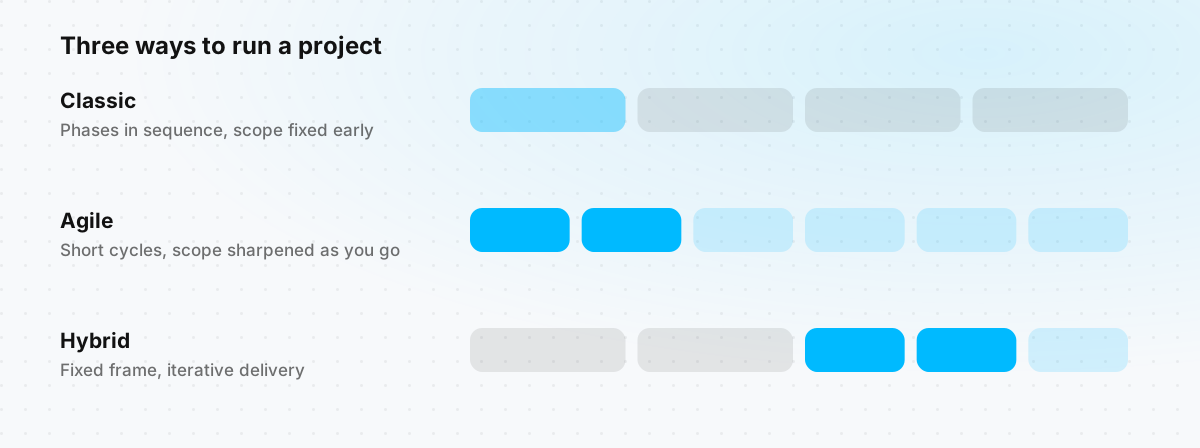
We will first examine the classic approach, with its focus on structured, proven procedures. Classic project control follows a linear phase model that guides projects from initiation to closure in clearly defined steps. Each phase has specific goals, deliverables, and milestones before the next one begins.
Classic methods with linear phases and detailed planning are particularly well suited to predictable industrial projects. In concrete terms: if, as a production manager, you are running a project where requirements, technologies, and conditions are clearly defined from the outset, the classic method offers maximum planning certainty.
An overview of the core characteristics of classic project control:
- Requirements specification and functional specification: The client sets out what is required in the requirements specification, the contractor sets out how it will be delivered in the functional specification — both documents later serve as the reference for acceptance.
- Binding baseline plan: The approved plan covering scope, dates, and costs is frozen and from then on serves as the reference against which every deviation is measured.
- Work breakdown structure and network planning: The undertaking is broken down into work packages; their dependencies and durations produce the critical path — the chain of activities with no float, where any delay pushes out the completion date.
- Change control board as the deciding authority: The impact of a change request on schedule, cost, and quality is assessed within the project, but the decision itself is made by a body appointed for that purpose.
Typical application areas for classic project control in industry include plant engineering, infrastructure projects, series projects in the automotive industry, and certification initiatives. In these contexts, requirements are fully known from the start, changes are costly, and compliance with norms and standards is mandatory.
A concrete example: a mechanical engineering company is planning the commissioning of a new production line. Delivery dates, technical specifications, and budget limits are fixed by contract. Here, classic project planning, with its structured phases and clearly defined responsibilities, offers the ideal framework. Deviations are identified early and can be corrected through targeted countermeasures.
A key advantage of the classic method is traceability. Every decision is documented, every change is formally recorded, and everyone involved knows exactly where the project stands at all times. This is indispensable, especially in regulated industries such as pharmaceuticals, energy, and aerospace.
The limits of the classic method become apparent when requirements change during the course of the project or when innovation is called for. That is when the rigid phase structure becomes a brake. Changes require formal change requests, new rounds of planning, and often considerable time. In such situations, more flexible approaches are needed.
Agile and Hybrid Methods: Flexibility for Industrial Innovation
Alongside the classic method, agile and hybrid approaches are gaining importance, particularly in areas of industrial innovation. Agile project control is based on the principle of iterative development: instead of planning the entire project in full from the outset, work happens in short cycles, each delivering concrete results and leaving room for adjustments.
Agile methods are well suited to dynamic environments and innovative developments, and hybrid approaches are often the optimal solution. This is an important insight for industrial companies: purely agile methods, as commonly used in software development, cannot be applied one-to-one to industrial projects. The solution often lies in hybrid approaches.
The key characteristics of agile project control:
- Iterative cycles of fixed length: Work happens in short timeboxes of equal length, each ending with a verifiable result rather than a mere interim report.
- Prioritized backlog: In place of a frozen scope of work, there is an ordered, continuously maintained list of requirements that governs what gets implemented next.
- Incremental delivery: Every cycle produces a usable partial result that can be assessed early and redirected if needed, before effort flows in the wrong direction.
- Empirical control: Transparency, inspection, and adaptation are the three pillars — decisions rest on observed results and not on planning assumptions.
- Cross-functional, self-organizing teams: The team brings together the necessary skills and decides on its own responsibility how to reach the solution within the agreed goal.
- Regular retrospectives: After every cycle, the team reviews its collaboration and its way of working and agrees on concrete improvements for the next round.
Hybrid project control combines the planning certainty of classic methods with the flexibility of agile approaches. A typical hybrid model in industry might look like this: the overall project structure, milestones, and budget are planned classically and fixed by contract, while the operational execution of individual work packages happens in agile sprints that allow for rapid adjustments.
A hybrid model is a good fit especially when your project needs a clear overall structure, but individual work packages are marked by high uncertainty. Define clear interfaces between the classic framework and the agile sub-projects to minimize friction.
Concrete application areas for agile and hybrid methods in industry include product development projects, digitalization initiatives, research and development projects, and the introduction of new manufacturing technologies. In these areas, requirements are often not fully known at the outset, technologies continue to evolve, and customer feedback needs to be incorporated quickly.
A practical example: an automotive supplier is developing a new sensor module for autonomous driving. The technical requirements change with every new version of the relevant standards. Here, a hybrid model makes it possible to keep the overall framework stable while the development team responds to new requirements in two-week sprints. The result is a significantly shorter time-to-market while still meeting the overarching project goals.
Another advantage of hybrid methods is improved collaboration between departments. When project management, specialist departments, and suppliers work within a shared system, fewer information gaps arise and coordination effort drops noticeably. Digital platforms that support both classic scheduling and agile task boards are especially valuable here.
Special Forms: PMO Types and Project Organization Structures in Industry
The structure of the project and of the organization itself has a decisive influence on which type of control can actually be used. Before choosing a type of project control, you should understand what organizational conditions exist in your company and which PMO structure (Project Management Office) best fits your requirements.
PMO types such as supportive, controlling, and directing are particularly relevant for standardizing processes in industrial companies. Each PMO type has specific responsibilities and suits different company sizes and project cultures.
Regardless of the PMO type, effective control stands or falls with the right tool: a supportive PMO needs different software functions than a directing PMO that actively assigns resources. Which system categories come into question is covered by the multi-project management software comparison.
Besides the PMO type, the project organization structure is decisive. Project organization structures such as staff, pure project, and matrix organizations differ fundamentally in how they distribute responsibilities and resources, with the matrix organization being the most common in industry.
The three most important project organization structures compared:
- Staff project organization: The project manager sits alongside the line organization as a staff position without authority to issue directives, coordinating, reporting, and preparing decisions, while employees remain entirely within their specialist departments — organizationally lean, but dependent on the departments' willingness to cooperate when it comes to getting things done.
- Pure project organization: For the duration of the project, those involved are taken out of the line organization and report to the project manager both functionally and in disciplinary terms — high impact on large-scale undertakings, but at the cost of the effort required for utilization and for returning employees to the line once the project ends.
- Matrix organization: Employees belong to their specialist department and to one or more projects at the same time, and the authority to issue directives is split between line and project — flexible in how resources are deployed, but with a permanent need to coordinate priorities and capacity.
The matrix organization is especially widespread in industry because it allows subject-matter experts to be deployed across projects without permanently removing them from their specialist department. This is especially important when specialists are needed in multiple projects at the same time.
Industrial companies with many external suppliers face additional requirements for project organization. Project organization involving suppliers requires clear interfaces, defined communication channels, and a digital platform that brings all parties together in a shared system. Without these structures, information gaps arise that lead to delays and quality problems.
Digital tools that support project organization are playing an increasingly important role. They make it possible to monitor resource utilization in real time, identify capacity conflicts early, and seamlessly integrate supplier information into project planning. This transparency is indispensable, especially in matrix organizations, where resources are split between line function and project.
Comparing Types of Project Control: Which Model Fits Your Use Case?
To make the decision easier, we compare the most important types of control and their application areas directly. A structured comparison helps you quickly grasp the strengths and weaknesses of each method and make the right choice for your specific project.
| Criterion | Classic | Agile | Hybrid |
|---|---|---|---|
| Planning certainty | Very high | Low to medium | High |
| Flexibility | Low | Very high | High |
| Documentation effort | High | Low | Medium |
| Suitability for clear requirements | Very good | Less suitable | Good |
| Suitability for innovation projects | Less suitable | Very good | Very good |
| Resource planning | Detailed, upfront | Rolling | Combined |
| Risk management | Structured, formal | Continuous, iterative | Structured and iterative |
| Typical project size | Medium to large | Small to medium | All sizes |
Classic methods based on DIN or AHO standards are particularly well suited to high-risk, schedule- and cost-driven industrial processes, while agile methods suit innovative developments, and hybrid approaches are often the optimal solution.
For a structured decision-making process, we recommend the following steps:
- Characterize the project: Assess your undertaking against the selection criteria listed above.
- Review the framework conditions: Clarify which contracts, norms, and evidence obligations force detailed upfront planning, and where room to maneuver remains.
- Align with the organization: Check whether the project organization structure, PMO type, and process maturity actually support the intended type of control.
- Define the delivery approach: Decide on a plan-driven, agile, or hybrid model and name the work packages that are to run iteratively.
- Determine control metrics and tools: Set KPIs, reporting cadence, escalation paths, and digital support before implementation begins — metrics introduced after the fact provide no basis for comparison.
- Review the decision: Reassess the choice of method at the agreed milestones and adjust it if requirements, technology, or framework conditions have shifted.
Concrete recommendations by project type:
- Series projects in the automotive industry: A classic framework with staged maturity-level approvals — the VDA maturity level assurance for new parts checks product and process maturity at defined points and involves suppliers all the way through to the start of series production.
- Product and technology development: Hybrid, following the Agile-Stage-Gate pattern — binding gates for budget and approvals, with iterative development cycles and short feedback loops in between.
- Digitalization and IT initiatives: Agile at the core, with a fixed budget and schedule framework on the outside — prioritization runs through a continuously maintained backlog, and acceptance happens per increment rather than only at the end of the project.
- Internal optimization projects: Control lightweight — a visual task board, short coordination cycles, and clear responsibilities are enough with a small team and low external risk.
Choosing the right method is not a one-time decision. Projects evolve, requirements change, and organizations mature. Stay open to more flexible project control that can adapt to changing conditions (our founder interview with Michael Sindlinger touches on that same "stay fast and flexible" idea). The best project managers are not the ones who apply a method dogmatically, but those who pragmatically find the best solution for each situation.
A common mistake in practice is assuming that a method, once chosen, must remain fixed for the entire project duration. In fact, it can make sense to plan classically at the start of a project and shift to agile elements during implementation once it becomes clear that requirements are changing faster than expected. This flexibility, however, requires clear communication with everyone involved and a digital platform that supports both approaches.
Practical Experience: Why a Mix of Methods Is Indispensable in Industry
Finally, a practical look at the specific challenges and solutions in the industrial project environment. Anyone who manages projects in industry knows: reality rarely fits into a single methodological model. Projects are too complex, organizations too heterogeneous, and requirements too dynamic for a single type of control to solve every challenge.
Our experience shows that a purely one-method approach to project control regularly hits its limits in industrial settings. A purely classic model fails when requirements change mid-project and no mechanisms exist for rapid adaptation. A purely agile model fails when supplier contracts, regulatory requirements, and budget limits make detailed upfront planning mandatory.
The uncomfortable truth is that many companies choose their type of project control not based on objective criteria, but based on what has historically grown within the company or what leadership knows from other contexts. This leads to method mismatches that manifest as delays, cost overruns, and quality problems.
Hybrid models and digital tools contribute substantially to efficiency gains, especially when applied consistently. This does not mean every company must immediately implement a complete hybrid framework. Often, it is enough to introduce digital support at the critical handover points between project phases and to integrate agile elements exactly where flexibility is genuinely needed.
Digital tools are especially valuable in industry for preventing knowledge loss and ensuring smooth handovers. In complex industrial projects, handovers often fail due to unstructured knowledge transfer, which is why digital tools are essential for effective control. This is a finding we can fully confirm from practice. When an experienced project manager leaves a project or a phase is completed, valuable knowledge is lost without structured digital documentation.
Digital task tracking is a concrete and immediately effective approach here. When every work package, task, and dependency is captured in a central system, successors can pick up seamlessly, status reports are generated automatically, and bottlenecks become visible before they turn into problems.
Our clear recommendation: stay open to a mix of methods and invest in industry-appropriate digital tools. The question is not whether you control your project classically or with agile methods, but how you combine the strengths of both approaches to best meet your specific project requirements. Companies that consistently take this step report significantly shorter project durations, lower cost variances, and noticeably better collaboration between departments and with suppliers.
Effective Project Control in Practice: Your Next Steps
Anyone who wants to make the most of a mix of methods and digital tools should take the next step toward practical implementation. The methods and decision criteria described in this article are a solid starting point. But the real value only emerges once these insights are put into practice within your company.
Linetrack helps project managers and production managers achieve exactly that. The platform combines classic project planning with Linetrack with agile elements in one integrated solution built specifically for the needs of industry. With automated scheduling, plan-driven scenarios, and a central portfolio overview, you keep track even in complex multi-project environments. The integrated resource management for projects surfaces capacity conflicts early and enables well-founded decisions. For companies running multiple parallel projects, Linetrack's multi-project management solutions provide a central control layer that creates transparency across all projects. Book a demo now and see how Linetrack takes your project control to the next level.
FAQ