Comparison
Linetrack vs.
Microsoft To Do

In short
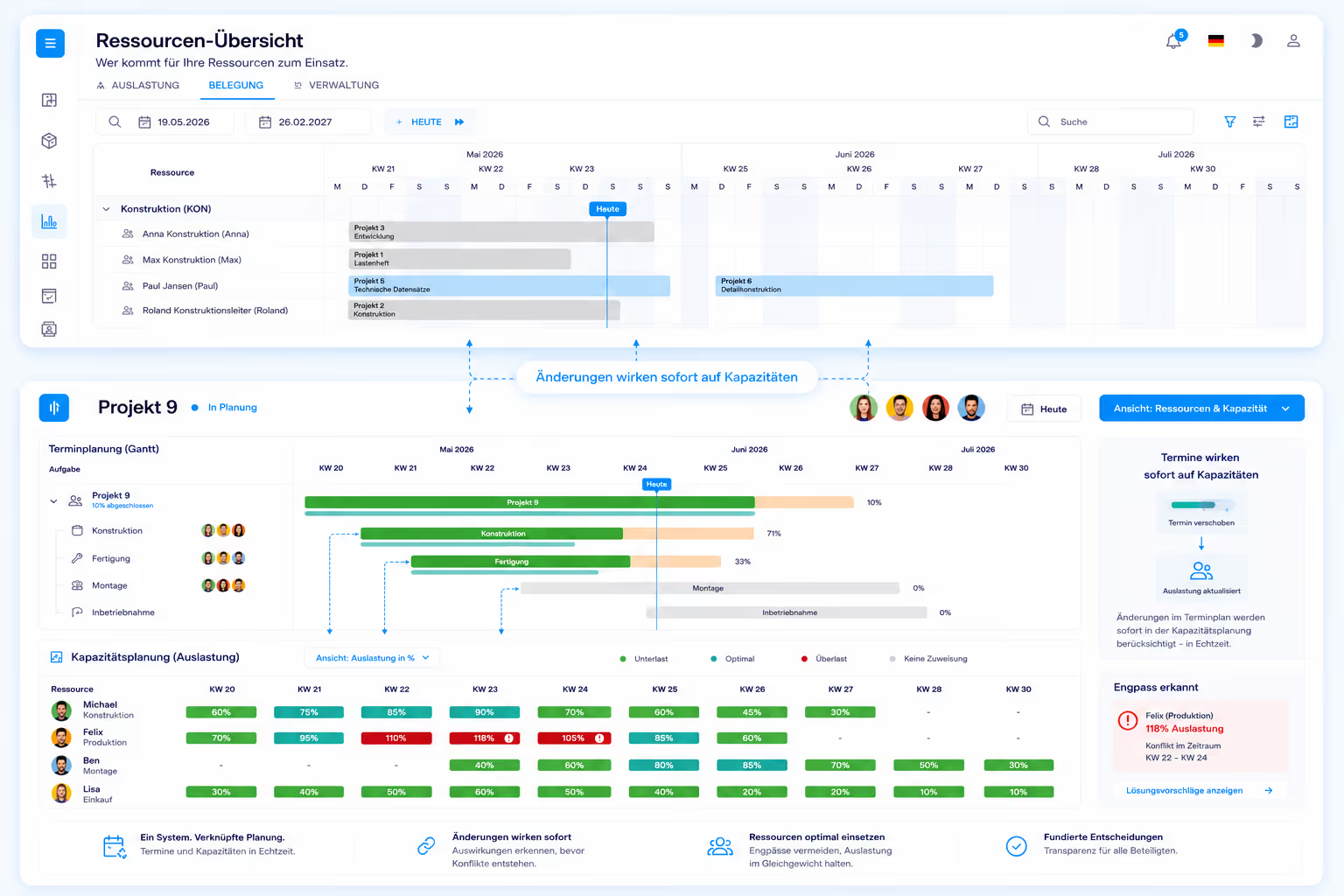
Microsoft To Do and Linetrack work on different levels. To Do is one person's own task list: free with a Microsoft account, synced with Outlook tasks and well suited to planning your own day. Engineering projects are planned on three levels, from project planning through detailed planning with staff scheduling to task tracking by employees. To Do covers part of the lowest level and knows neither dependencies nor capacity. Linetrack connects all three levels on a shared data basis, and employee feedback arrives on the task in the project plan. If you run complex projects across several departments, you need that connection. A task list does not create it.










91 %
named Excel and tool sprawl
as their starting problem
59 %
named manual status chasing
as their starting problem
1512+
industrial projects
managed in parallel
10 days
from kick-off
to go-live
Every figure on this page comes from a full survey of all live Linetrack implementations, as of August 2026. Multiple answers were possible for the starting problems.
Starting point
What Microsoft To Do was built for
Microsoft describes To Do as a simple and intelligent to-do list app for managing your day. That is exactly what it is built for. Each person keeps their own lists with tasks and due dates; the app is included free with every Microsoft account and needs no setup. Tasks sync with Outlook. For work and school accounts, tasks assigned to a person in Planner also appear in the "Assigned to me" list.
For working together there are shared lists. You invite other people via a link, and from then on every member can view, add, edit and delete everything in that list. There are no roles. Microsoft therefore positions To Do as a personal tool; scheduling with dependencies is handled in its separate product Microsoft Project. Which system categories are worth considering for engineering projects is covered in the software comparison.
Planning levels
Which level To Do works on
In mechanical and plant engineering, planning happens on three levels. In project planning, sales and project management produce the schedule and the resource forecast, usually with tools such as MS Project or Primavera. The demand per department should flow from there straight into the departments. On the second level, department heads plan their area in detail and assign staff a few weeks before the work phase begins, often in a detailed scheduling system or in Excel lists. At its core, this staff scheduling is the assignment of a person, a task and a due date. That produces the third level, task tracking by employees. Microsoft To Do belongs on this lowest level, and within it on the most personal part: one person's own task list.
In most companies today, every level has its own island. The schedule sits in MS Project, staff scheduling in Excel, and tasks are kept in To Do or handed out by word of mouth. None of these solutions talks to the others. Linetrack connects the islands on a shared data basis: project management plans at a high level, department heads plan in detail down to individual employees, and feedback on tasks arrives on the task in the project plan. For complex projects Linetrack is therefore the right system, because only the connection between the levels shows whether a date will hold. The framework is described on the multi-project management page.
Breaking point
Where the task list reaches its limit
The limit of To Do is not ease of use. It is the point where many individual tasks are supposed to become one shared project plan.
None of this is a flaw in Microsoft To Do. A personal task list needs neither dependencies nor capacity. An engineering project needs both, plus a schedule in which shifts ripple through the chain of linked tasks. How dates and capacity fit together is described on the scheduling and capacity planning page.
Core argument
To Do collects tasks, Linetrack connects the levels
Task and agile tools such as Trello, Asana, Monday, Stackfield or Microsoft To Do are good at task management. At their core, they collect tasks. To Do is the most personal form of this: the list of a single person, free and right next to Outlook.
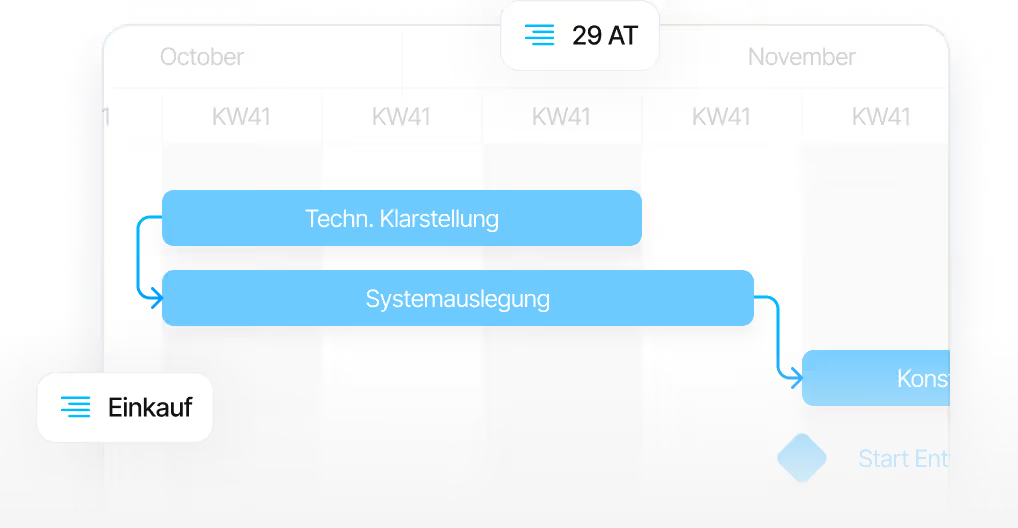
An engineering project cannot be run on collected tasks. Design before production before assembly, the same departments in twenty parallel projects, suppliers with their own dates: no task list captures that complexity. In Linetrack, collecting tasks is the lowest level. Project planning and detailed planning sit above it, in the same system.
The test: ask whether engineering is overbooked in March across all projects. To Do cannot answer that, because it knows no resources and no workload. In Linetrack the answer is in the capacity histogram directly below the bar chart, across all projects.
On the lowest level, employees see their tasks in Linetrack on the desktop or in the mobile app and report status directly on the task. The plan turns into actuals. Project control compares the two and plays through scenarios in the system; nothing is rescheduled automatically, people make the decisions. If you need a comprehensive system for complex projects, Linetrack is therefore the one to use. What plan and actuals look like side by side is shown in the plan-vs-actual comparison.

Side by side
Microsoft To Do
versus Linetrack
Seven points where the difference in scope shows up day to day. What is compared is what each tool is built for, not the length of its feature list.
On cost, To Do is ahead, and the app needs no implementation either. The other rows describe the gap between a personal list and a system for collaborative project management. Microsoft To Do details as of our own research based on Microsoft's support documentation, August 2026.
Security & Trust
Your data. Secure in Germany.
Linetrack runs entirely within the EU – hosted with an ISO-certified partner, fully encrypted, and backed up regularly.
Made in the EU
GDPR-compliant
Hosted in Germany
Application, database, and backups run exclusively with Hetzner in the Falkenstein data center.
Fully GDPR-compliant
Your data is processed and stored exclusively within the EU.
ISO/IEC 27001:2022-certified data center
Our hosting partner operates the data center to the internationally recognized ISO/IEC 27001 security standard.
Encrypted in transit and at rest
Data transmission via TLS 1.2/1.3, storage secured with AES-256 encryption.
Multi-tier backups
Hourly, daily, and monthly backups with a typical recovery time of under one hour.
Honest boundaries
When Microsoft To Do is enough
For many tasks, To Do is the right tool. Four cases in which the app is sufficient:
The picture changes with many parallel projects in which departments share the same people and dates depend on each other. There, no task list is enough, not even a shared one. If you need a comprehensive system for such projects, you should use Linetrack: it connects project planning, detailed planning and task tracking and replaces the isolated solutions on each level. What that looks like in mechanical and plant engineering is described on the industry page.
Switching
How tasks arrive in Linetrack
When switching, the first step is to build the plan the tasks come from. Linetrack reads existing schedules and lists from Excel, MS Project, Primavera or SAP through its standard import. After that, project management plans at a high level, and department heads plan their area in detail down to individual employees.
In staff scheduling, the department head assigns a person and a due date to a task. That is exactly what reaches employees as a task, on the desktop or in the mobile app. They report their status directly on the task, and project management sees it in the plan without having to ask.
It takes ten working days from kick-off to go-live. Data is hosted in ISO 27001 certified data centres in Germany, and testing before the decision is free of charge. The process is described on the implementation page.
FAQ
Frequently asked questions
Still have questions?
Book a meeting with our team.
Is Microsoft To Do a project management tool?
Is Microsoft To Do a project management tool?
What is the difference between Microsoft To Do and Linetrack?
What is the difference between Microsoft To Do and Linetrack?
Can I plan task dependencies in Microsoft To Do?
Can I plan task dependencies in Microsoft To Do?
Can I work on tasks as a team in Microsoft To Do?
Can I work on tasks as a team in Microsoft To Do?
How do Microsoft To Do, Planner and Project relate to each other?
How do Microsoft To Do, Planner and Project relate to each other?
What does Linetrack cost compared with Microsoft To Do?
What does Linetrack cost compared with Microsoft To Do?
More comparisons
Learn more
Linetrack in detail
The modules Linetrack uses to connect the three planning levels: