Resource Management: Steering Projects Efficiently and Reliably
Resource management in projects: methods, standards such as PMBOK and DIN ISO, and common bottlenecks for reliably planning staff, materials, and time.


Three out of four industrial companies are already implementing measures to improve resource efficiency, yet only one in two also closes internal material loops, as a VDI ZRE study shows. This gap between intent and consistent implementation costs industrial companies productivity, planning certainty, and competitive advantage every day. For project managers and production managers, this means: anyone who treats resource management as a mere operational chore falls behind competitors who use it strategically. This article shows you which methods, standards, and solutions actually work.
Key Takeaways
| Point | Details |
|---|---|
| Multi-layered resources | Personnel, materials, time, and finances must all be given equal consideration in an industrial setting. |
| Efficiency through methods | Tools such as capacity planning and a skills matrix measurably improve resource utilization. |
| Standards provide confidence | Recognized frameworks such as PMBOK and DIN ISO provide a clear framework for sustainable success. |
| Concrete challenges | Illness, staff turnover, and planning errors require flexible, forward-looking strategies. |
| Practical relevance is key | Optimization only succeeds with pragmatic tools, continuous analysis, and clear communication. |
Fundamentals and Importance of Resource Management in Industry
In many companies, resource management is a term used often but rarely defined precisely. Yet a clear definition is the foundation for effective control. Resource management covers the planning, allocation, and control of personnel, time, materials, machines, spaces, and finances in industrial companies. It is therefore not just about personnel capacity, but about all the factors of production needed to carry out a project.
In complex industrial projects — for example in mechanical and plant engineering, the automotive industry, or process industries — these resources are rarely available in abundance. Multiple projects run simultaneously, specialists are claimed by different departments, and supply chains react sensitively to changes in plans. Without structured resource management, bottlenecks, delays, and cost overruns emerge that directly affect the outcome.
Typical types of resources in industrial projects include:
- Personnel and qualifications: What matters is not headcount but whether design, electrical engineering, software, or commissioning capacity is free in exactly the window needed; authorizations and instruction requirements further limit who may take on a task at all.
- Machines and operating equipment: Production systems, test rigs, and special tooling cannot be moved — the order moves, not the capacity; whoever occupies them also blocks every downstream step that builds on them.
- Material and supplied parts: The confirmed delivery date sets the earliest possible start of entire work packages; if it slips, the personnel and equipment bookings slip with it.
- Space and infrastructure: Assembly and test areas are occupied for weeks at a stretch and cannot be booked by the hour; they therefore limit parallel project throughput sooner than staffing levels do.
- Financial resources: Budget approvals and payment schedules determine whether external capacity can be bought in on time — the financial resource thus indirectly limits the human one.
- Time: Time cannot be increased, only allocated differently; shift models, plant shutdown periods, and blackout periods set limits that no amount of replanning removes.
"Resource management is not an end in itself. It creates the conditions for projects to be completed on time, within budget, and at the agreed quality level."
For production managers, resource control is a daily reality: when a machine breaks down unexpectedly or a key employee falls ill, the quality of resource planning determines how quickly and reliably the team can respond. Anyone who treats resource control as a continuous process builds in the buffers and transparency that make the difference in critical moments — the feature layer behind it is the resource manager in Linetrack.
Core Tasks and Methods in Resource Management
After the fundamental importance comes concrete implementation. How are resources actively planned, controlled, and monitored? The core tasks can be broken down into five areas:
- Determine demand: Derive from the project structure and work packages which qualifications, equipment, and funds are needed in which period — first as quantity and profile, still without specific names.
- Net off availability: Dependable capacity only emerges after deducting vacation, part-time and shift models, plant shutdown periods, and equipment time that is already booked.
- Allocate and resolve conflicts: Bring demand and availability together, make double bookings visible, and resolve them by rescheduling, redistributing, or buying in capacity.
- Track consumption: Continuously compare what was planned against what was actually used, so that deviations surface while they are still small.
- Correct course and capture experience: Respond to deviations and feed the actual effort back into the next demand estimate.
The most important methods in resource management include capacity planning, resource leveling, skills matrices, workforce planning, what-if scenarios, and dashboards. Each of these methods has its own specific application area and strengths.
Pro tip: the skills matrix is an often underestimated tool. It systematically documents which skills exist within the team and at what level. Once you know which employee holds which qualifications, you can deploy resources more flexibly, close gaps through targeted training, and reduce dependency on individual key people. An up-to-date skills matrix is especially valuable when projects need to be replanned at short notice.
The key lies in connecting the operational and strategic perspectives: operational resource control reacts to current requirements, while strategic resource planning anticipates future needs. How both levels run on one shared data basis instead of separate department spreadsheets is described on the resource and capacity planning page.

| Dimension | Operational Resource Control | Strategic Resource Planning |
|---|---|---|
| Time horizon | Short-term (days to weeks) | Medium- to long-term (months to years) |
| Goal | Resolve bottlenecks, secure ongoing projects | Build capacity, implement portfolio strategy |
| Methods | Resource leveling, shift planning | Workforce planning, scenario analysis |
| Responsibility | Project managers, team leads | Production managers, executive management |
| Data basis | Current utilization data | Historical data, forecasts, market trends |
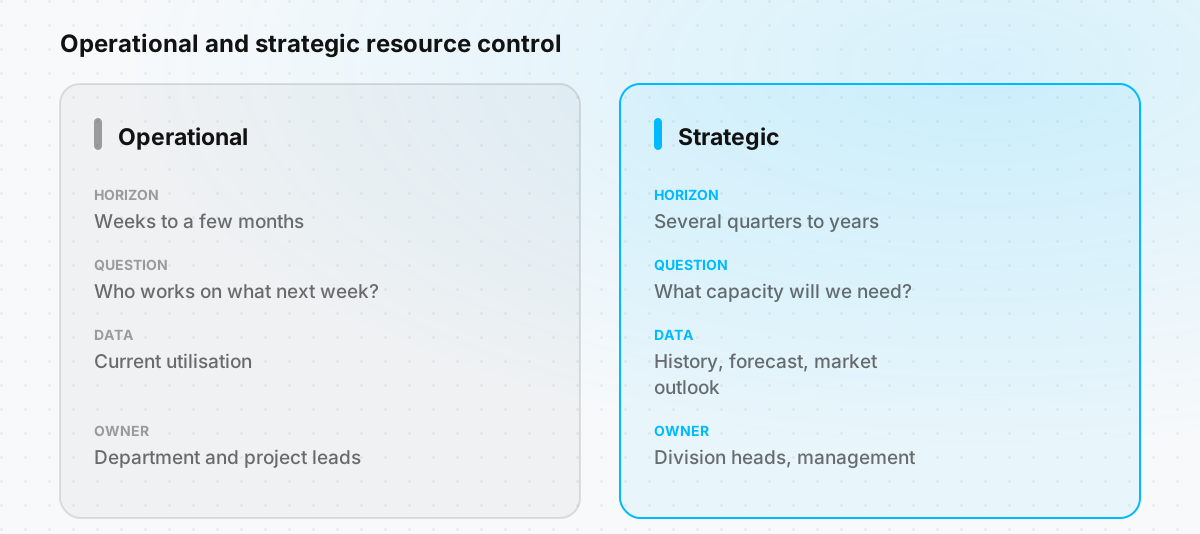
This distinction is crucial in practice. Many companies are strong on operational control but neglect the strategic perspective. As a result, the same bottlenecks keep recurring because the root causes are not addressed systematically.
Standards, Frameworks, and Best Practices
Having covered the methods, we now turn to established knowledge: the standards and best practices that give project managers and production managers guidance. The authoritative standards for resource management in projects are the PMBOK Guide from the Project Management Institute (PMI), as well as DIN ISO 21500 and 21502.
The PMBOK Guide defines resource management as a distinct knowledge area with clearly described processes: from planning, through acquiring and developing resources, to controlling resource use. DIN ISO 21500 offers an internationally recognized framework for project management that is increasingly used as a reference by German industrial companies as well. DIN ISO 21502 goes deeper into the requirements for project execution and control.
In practice, these standards are rarely implemented one-to-one. Instead, they serve as a reference framework from which companies adopt the elements relevant to them. Especially in standards-based project planning, it becomes clear that consistently aligning with standards significantly eases communication between departments, suppliers, and customers.
| Standard/Framework | Strengths | Limitations |
|---|---|---|
| PMBOK Guide (PMI) | Comprehensive, internationally recognized, practice-oriented | Complex, high implementation effort |
| DIN ISO 21500 | Standardized, easy to integrate, rooted in Europe | Less detailed than PMBOK |
| DIN ISO 21502 | Focused on project execution, up to date | Still not widely adopted in practice |
| Agile frameworks | Flexible, iterative, quickly adaptable | Less suitable for heavily regulated industries |
Proven best practices for implementation in production include:
- Identify the bottleneck first: Establish which resource actually limits throughput — the specialist, the test rig, or the assembly area — and direct planning effort and data maintenance there first, instead of planning every resource in the same fine detail.
- Create a shared data foundation: Uniform resource calendars, capacity definitions, and planning grids are the precondition for reports from design, production, and assembly to be comparable at all.
- Separate coarse and detailed planning: Plan distant periods only coarsely at the level of project phases and refine only the coming weeks down to individual people and machines; otherwise maintenance costs more than the added precision returns.
- Qualify the people involved: Team and department leads who report and maintain capacity need training and documented procedures; otherwise the standard remains a pure formality.
- Make resource commitments binding: An allocation only holds once the department giving up the capacity has confirmed it — for a named period and a fixed scope. Without that confirmation the plan is a request, and the commitment falls apart at the first clash with day-to-day work.
- Put procurement and external work in the same plan: Bought-in parts and subcontracted work with long lead times have to be ordered well before your own capacity is needed for them. Order and award dates therefore belong in the project plan as dates of their own, not in a separately kept procurement list.
- Check your own estimates afterwards: After a project closes, evaluate how far estimated and actual effort diverged per team. Knowing that gap across several projects lets you correct the next estimate with an evidenced factor instead of a gut feeling — and lets you justify buffers rather than negotiate them.
Choosing the right framework depends on the company's structure, its project landscape, and the competencies available. For industrial companies with complex, parallel projects, a combination of standardized processes and digital tools has proven especially effective.
Typical Challenges and Solutions in Practice
The theoretical overview is now complemented by everyday, industry-specific experience. Even well-planned resource strategies run into concrete obstacles in practice. Typical bottlenecks arise from illness and resignations, from competition between parallel projects, from imprecise estimates, and from dependency on key individuals.
These bottlenecks are not exceptions — they are everyday reality in industrial companies. A mechanical engineering company running several customer projects simultaneously knows the problem well: two projects need the same specialist in the same week. Without a transparent capacity overview and clear priority rules, the loudest project manager wins out in the end, not the strategically more important task.
Common sources of error in resource management include:
- Planning inside the project silo: Every project plans its resources on its own, without knowing the overall demand across all ongoing and planned undertakings; conflicts only become visible once they have already occurred.
- Line and service work left out: Maintenance, complaint handling, quotation work, and training tie up real capacity, yet do not appear in many project plans.
- Planning without reserve: Anyone who schedules employees and equipment to full utilization removes every buffer for illness, rework, and coordination before the project has even started.
- Outdated plan versions: Resource plans kept in scattered spreadsheets age quickly; decisions are then based on figures that no longer reflect actual bookings.
- Commitments without a counter-check: Dates are confirmed to customers before the departments involved have confirmed their capacity at all — the commitment stands, the coverage does not.
- Capacity calculated without qualification: Anyone who only counts hours instead of mapping skills overlooks that specialist tasks cannot be redistributed to other people at will.
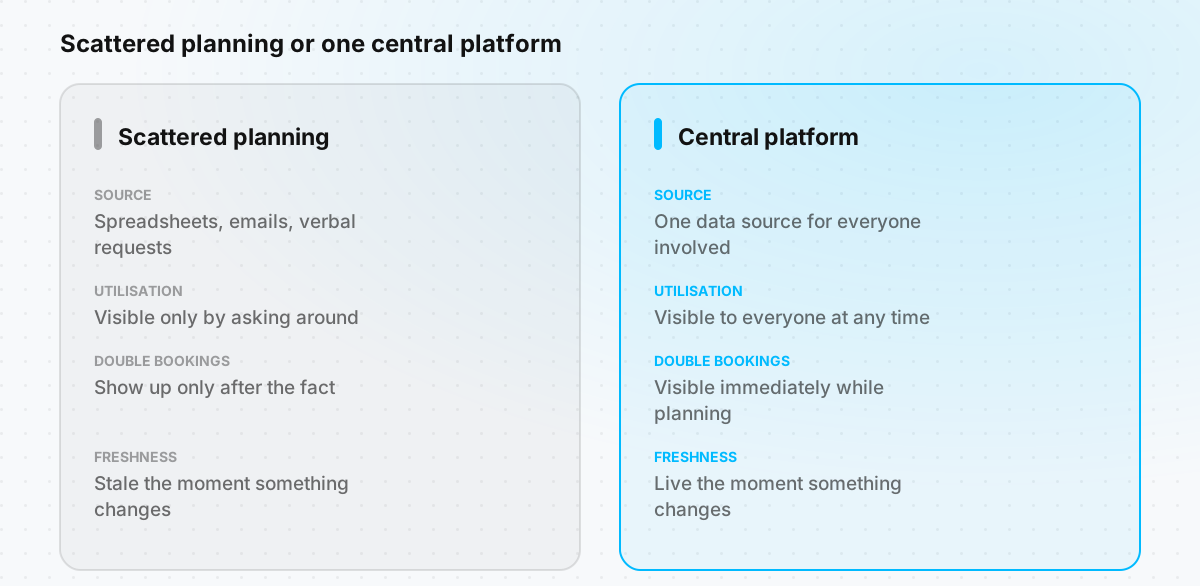
Practical industry solutions address these weak points in a targeted way. Multi-project management in daily practice requires a portfolio overview that brings together all ongoing and planned projects with their resource needs. Only this way can conflicts be identified and prioritized before they escalate.
Pro tip: carry out resource leveling early, ideally already during the planning phase. If you only recognize resource conflicts once the project is underway, your options are limited and the cost of fixing them is much higher. Combine resource leveling with targeted skill development: if you know which skills will be needed in six months, you can start qualifying people today.
Flexibility in resource management also means being able to respond quickly to unforeseen events (more on that "fast and flexible" idea in our founder interview with Michael Sindlinger). Companies that prepare what-if scenarios — i.e., alternative resource plans for critical situations — respond to disruptions significantly faster and with less friction.
Another solution is the systematic reduction of dependencies. When critical knowledge is concentrated in just a few people, a structural risk emerges. Knowledge transfer, documentation, and cross-training are not luxury measures — they are necessary investments in the organization's resilience.
Measurable Results and Current Trends in Resource Management
Having outlined the challenges, we now turn to the evidence that targeted resource management can genuinely boost efficiency. Figures and case studies make the difference between theory and practice tangible.
"Resource efficiency is not a cost factor, but a competitive advantage. Companies that systematically optimize their resources achieve measurable benefits in throughput times, costs, and quality."
The VDI ZRE study shows that 75 percent of small and medium-sized enterprises are already implementing measures to improve resource efficiency. At the same time, only 50 percent close internal material loops. This discrepancy shows that many companies have taken the first step but have not yet realized their full potential.
A concrete example from industry is the Nobra GmbH case study: by deploying the Efficios system, the company achieved significant energy savings through the optimization of compressed air and gas. This example shows that resource optimization concerns not only personnel and time, but also energy resources, which represent a substantial cost factor in production.
Current trends in resource management include:
- Qualifications as a planning dimension: Planning no longer runs against headcount and hours alone but against recorded skills, certifications, and equipment knowledge, because that is where the hard assignment limits sit.
- Real-time data instead of status reports: Utilization and work progress are reported back continuously from execution, instead of being tracked in periodic reports.
- AI-supported forecasts: Demand, schedule, and risk forecasts based on historical project data are finding their way into resource control, but in many organizations they are still at the pilot stage.
- Planning across plant and supplier boundaries: Capacity is no longer viewed per site alone; plants, extended workbenches, and suppliers are held in one shared view so that orders go where capacity is actually free.
- Capacity checks at the quotation stage: Whether a date can be committed to is increasingly checked against existing capacity before the quotation goes out, rather than being planned only once the order has arrived.
With task tracking in resource management, project managers can follow the progress of individual work packages in real time and spot deviations immediately. This creates the basis for proactive course correction instead of reactive firefighting.
The drivers behind innovative resource strategies are clear: rising cost pressure, the shortage of skilled workers, and growing project complexity. The obstacles are just as well known: poor data quality, resistance to change, and a lack of resources for introducing new processes. Companies that systematically address these obstacles secure a lasting competitive advantage.
Why Genuine Resource Optimization Is More Than a Software Rollout
There is a widespread assumption in industrial companies: if we roll out the right software, our resource problems will solve themselves. This assumption is understandable, but dangerous. Tools are an important enabler, but not a cure-all.
Experience from practice shows time and again: companies that introduce a new resource management tool without also changing their processes and communication culture achieve, at best, marginal improvements. The tool then just digitizes the old, inefficient processes instead of enabling new, better ones.
What really makes the difference are three factors that are often underestimated. First: cultural change. Resource management only works if everyone involved, from executive management to team leads, accepts and actively supports the need for transparent planning. Second: regular communication. Regular, structured coordination between project management, specialist departments, and suppliers is not bureaucracy — it is the foundation for reliable planning. Third: skill analysis. Anyone who does not know what skills exist within the team cannot carry out sound resource planning.
The shortage of skilled workers makes these challenges even more acute. When qualified employees are hard to find, developing existing talent internally becomes a strategic necessity. Companies that invest in skill development and document knowledge systematically are more resilient to personnel changes.
Resistance within the workforce is another factor that blocks resource optimization. New processes and tools mean change, and change creates uncertainty. Project managers and production managers who involve their teams early and communicate the concrete benefits of new approaches overcome this resistance much faster.
Our recommendation is clear: favor iterative improvement over one big-bang rollout. Start with an area where resource problems are especially noticeable, implement structured processes and digital support there, measure the results, and learn from them. This approach builds trust, delivers quick wins, and lays the groundwork for a broader rollout. Experience from resource planning confirms that personal accountability and clearly defined responsibilities are decisive here. Anyone responsible for resource decisions must know it and bear the consequences.
Solutions for Modern Resource Management: Your Next Step
Resource management in industry is complex, but solvable. The methods, standards, and best practices described in this article form the foundation. Implementation requires the right tools and partners.
Linetrack offers modern resource management solutions built specifically for the needs of industrial companies. The platform combines digital project planning with capacity planning, task tracking, and multi-project management tools that work across departments. Seamless integration with existing ERP systems ensures your data foundation stays consistent and that decisions are based on valid figures.
FAQ
Frequently Asked Questions About Resource Management
Steer resources reliably — with Linetrack
See in a 30-minute live demo how Linetrack brings resource management in industry onto a single, central platform: real-time utilization, what-if scenarios, and ERP integration, all in one system.