Comparison
Linetrack vs.
Oracle Primavera P6

In short
Oracle Primavera P6 and Linetrack are built for different jobs: P6 is the standard for very deep scheduling on large projects with a dedicated scheduler role, Linetrack the collaborative scheduling and capacity planning tool for industrial mid-sized companies. In P6 departments report their status upward; in Linetrack they maintain it themselves. Existing P6 schedules are imported by Linetrack as a ready-made standard feature. The difference lies in scope and operating model, not in quality.







1512+
industrial projects
managed in parallel
4000+
completed
industrial projects
91 %
named Excel and tool
chaos as their starting problem
10 days
from kick-off
to go-live
Every figure on this page comes from a full survey of all live Linetrack implementations, as of August 2026. They describe the entire customer base; no separate figures exist for replaced Primavera installations.
Starting point
What Oracle Primavera P6 was built for
Primavera P6 is a scheduling system for large projects. It comes from plant construction, EPC work, building and infrastructure – fields in which a single undertaking runs for years, reaches very high activity counts and where the schedule itself can be a contractual deliverable. The methodology is correspondingly deep: critical path method, several calendars side by side, finely grained work breakdown structures, plus cost and progress control down to the individual activity.
P6 comes in two forms: P6 Professional as a desktop client for the scheduling work itself, and P6 EPPM as a web-based environment for portfolio, reporting and collaboration. Both are meant for organisations in which scheduling is a role of its own. That is exactly where the break line sits for mid-sized mechanical and plant engineering: the role usually does not exist there – and the bottleneck is not the depth of a single plan but the coordination between twenty projects and six departments.
Planning levels
Where Primavera P6 sits in planning
Industrial projects are planned on three levels. At the top, sales and project management create the schedule and the resource forecast. Below that, departments plan their share in detail and assign staff. At the bottom, staff report the status of their tasks. Primavera P6 works on the top level, and very thoroughly: networks with high activity counts that often go to the customer as a deliverable.
P6 rarely reaches the two levels below. Departments plan in their own sheets or detailed scheduling systems, the planning role transfers feedback by hand, and ERP and time tracking need integrations of their own. Resources can be managed in P6, but rarely the way departments in machine building plan: as weekly capacity across all projects, maintained by the department itself. Linetrack plans the top level in less depth and connects it to department planning and task tracking. The Collaborative project management page describes how the upkeep is shared.
In practice
Where it breaks in mid-sized industry
The following six points are not a list of shortcomings. They describe what happens when a tool built for large projects is used in an organisation that runs many mid-sized projects at once and has no planning department of its own.
None of this is a flaw in P6. It follows from using a tool made for contractually owed schedules on large projects to steer many mid-sized ones. Which other system categories exist alongside it – ERP modules, agile tools, Gantt planners, Excel and detailed scheduling – is set out in the multi-project management software comparison.
Core argument
One scheduler or twenty co-planners
Primavera P6 is not a weaker tool than Linetrack. In scheduling it does more: critical path method, multiple calendars, very deep structures, progress and cost control down to the individual activity. Anyone steering a large project with a very high activity count and a contractual scheduling obligation is right to use it – and Linetrack is not built for that.
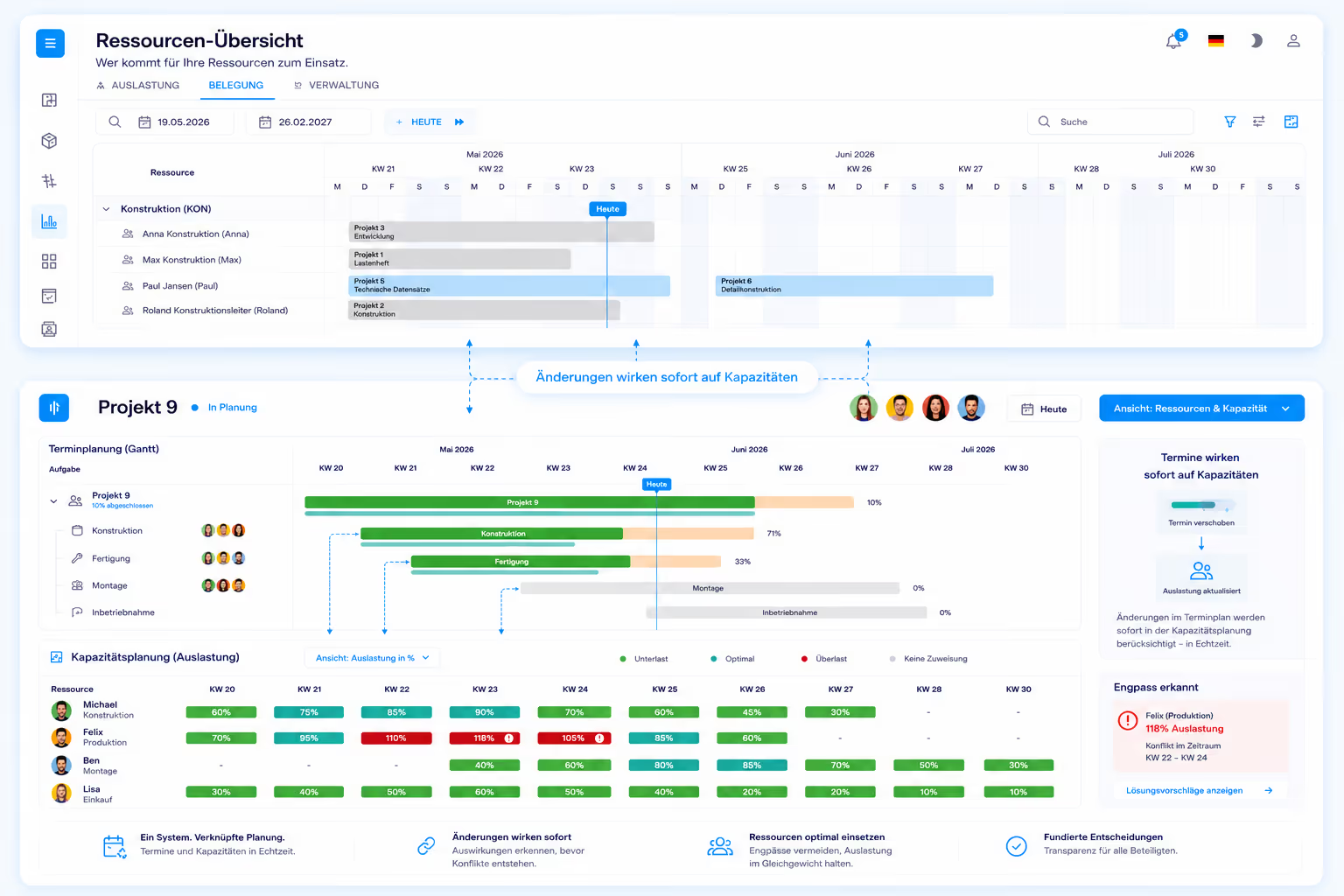
The difference lies in the operating model. P6 assumes that one person runs the plan. Linetrack assumes that many do: every role maintains its own share because it gets something out of it – the department its utilization, the project manager schedules and capacity, management the portfolio overview.
The test is a single question: who enters, on a Friday afternoon, that assembly will now start two weeks later? If there is a paid role for that, a deep planning system works. If there is not, what keeps the plan current is not methodological depth but whether the department looks into it itself.
The price of that choice belongs in the picture: Linetrack does not reach the analytical depth of P6. There is no scheduler bottleneck, but there is no forensic delay analysis either. How the distributed maintenance is organised, who holds which rights and what it hangs on is described on the collaborative project management page.

In comparison
Oracle Primavera P6
versus Linetrack
Seven aspects on which the two systems differ. None of them describes a deficiency – each describes a scope.
The scheduling depth row matters most. Linetrack calculates task relationships, derives the critical path from them and lets a shift ripple through the chain of dependent tasks, visible immediately in the Gantt bar chart. What P6 offers beyond that is the depth of the methodology: multiple calendars, finely grained work breakdown structures and the formal schedule analytics required for contractual proof. Conversely, in Linetrack the cross-project capacity histogram sits directly below the bar chart – the core of scheduling and capacity planning.
Security & Trust
Your data. Secure in Germany.
Linetrack runs entirely within the EU – hosted with an ISO-certified partner, fully encrypted, and backed up regularly.
Made in the EU
GDPR-compliant
Hosted in Germany
Application, database, and backups run exclusively with Hetzner in the Falkenstein data center.
Fully GDPR-compliant
Your data is processed and stored exclusively within the EU.
ISO/IEC 27001:2022-certified data center
Our hosting partner operates the data center to the internationally recognized ISO/IEC 27001 security standard.
Encrypted in transit and at rest
Data transmission via TLS 1.2/1.3, storage secured with AES-256 encryption.
Multi-tier backups
Hourly, daily, and monthly backups with a typical recovery time of under one hour.
Honest boundaries
When Primavera remains the right choice
There are situations in which Linetrack is the wrong answer. Four of them can be named plainly – without qualification and without a counter-argument.
In every other case – several departments, many parallel projects of medium size, no dedicated planning role – the question is not depth against depth but whether the plan stays current. That is the central question of multi-project management. Organisationally the two do not exclude each other: needing P6 for one large project does not mean the rest of the portfolio has to be run there as well.
Switching over
How the switch from Primavera works
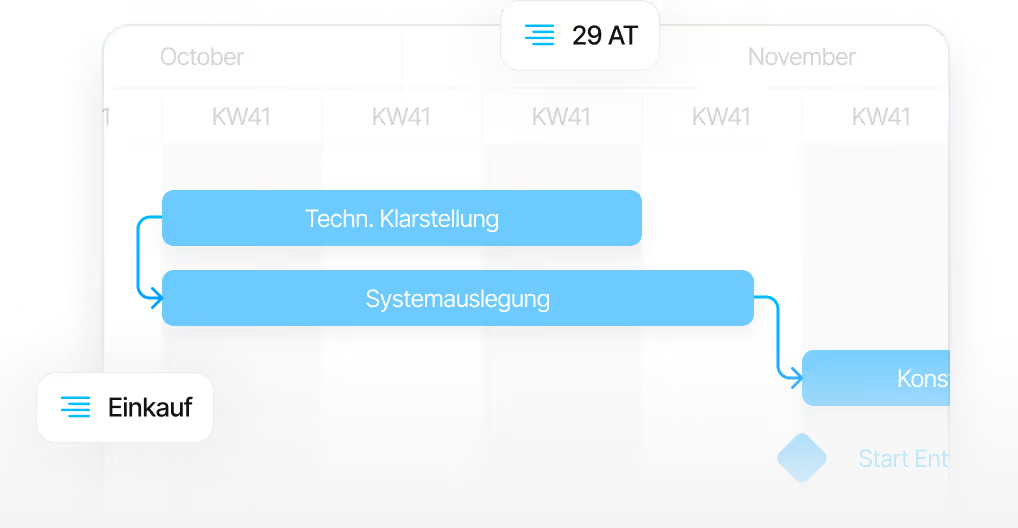
Importing existing Primavera schedules is a ready-made standard feature of Linetrack and part of the product: tasks, durations and dependencies are carried over instead of being retyped. No separate interface development is required for it, which takes the legacy schedules off the list of arguments against switching.
The qualification belongs with it: this import is a data migration, not a running synchronisation between the two systems. What Linetrack keeps permanently in sync is ERP, time-tracking and HR data; which systems those are in detail, and how they are connected, is listed under interfaces and integrations.
After that it is not the import that counts but the first plan of your own. It takes ten working days from kick-off to go-live – regardless of company size. The phased sequence is described on the implementation page; whether the scope fits your organisation is something we clarify in an initial conversation.
FAQ
Frequently asked questions
Still have questions?
Book a meeting with our team.
What is the difference between Oracle Primavera P6 and Linetrack?
What is the difference between Oracle Primavera P6 and Linetrack?
Is Linetrack a replacement for Primavera P6?
Is Linetrack a replacement for Primavera P6?
Can Linetrack take over existing Primavera schedules?
Can Linetrack take over existing Primavera schedules?
Does Linetrack calculate the critical path like Primavera P6?
Does Linetrack calculate the critical path like Primavera P6?
When is Primavera P6 oversized for a mid-sized company?
When is Primavera P6 oversized for a mid-sized company?
What does Linetrack cost compared with Primavera P6?
What does Linetrack cost compared with Primavera P6?
More comparisons
Learn more
Linetrack in detail
The modules behind collaborative scheduling and capacity planning: