Project Coordination: A Step-by-Step Guide to Maximum Efficiency
A practical step-by-step guide to project coordination: clear responsibilities, transparent workflows, and fewer delays in industrial projects.


Unclear responsibilities, a lack of transparency, and poor coordination between departments are among the most common causes of project delays in industrial companies. When resource conflicts go unnoticed and information does not flow in time, additional costs and schedule shifts arise that jeopardize the entire success of the project. This guide shows you step by step how to structure the coordination of your projects, create transparency, and sustainably optimize your workflows. You will get concrete methods, field-tested recommendations, and a clear framework for implementation.
Fundamentals of Successful Project Coordination
Project coordination refers to the systematic alignment of all activities, resources, and stakeholders within a project in order to achieve jointly defined goals on time and within budget. In industry, this typically includes coordination between project management, specialist departments, purchasing, production, and external suppliers. Without clear structures, friction losses arise that directly affect quality and on-time delivery.
Typical Roles and Their Responsibilities
A well-organized project team knows its roles precisely. The following overview shows which functions are particularly relevant in industrial project coordination:
| Role | Primary Responsibility | Typical Interfaces |
|---|---|---|
| Project manager | Overall control, reporting, escalation | All departments, client |
| Sub-project manager | Technical coordination within the sub-project | Project manager, specialist departments |
| Resource owner | Capacity planning, availability | Project manager, HR, production |
| Supplier manager | External coordination, schedule tracking | Purchasing, suppliers, project manager |
| Quality owner | Inspection, approvals, documentation | All project stakeholders |
This distribution of roles forms the foundation of every successful coordination effort. As soon as responsibilities are unclear, gaps in communication and duplicate work steps arise, costing time and budget.
Prerequisites for Solid Coordination
Three factors are decisive for the success of project coordination:
- Decisions that are made in time: Open items need a named authority and an agreed deadline within which a decision is reached; the evidence-based GPM study on success factors in project management counts timely and sufficient decisions among the most effective levers for project success.
- Bindingly standardized processes: Status reporting, approval, change requests, and escalation should be governed the same way across all projects, so that those involved do not have to renegotiate in every undertaking who supplies which information and when.
- A shared, up-to-date information base: Schedules, capacities, and task statuses must be readable for everyone involved from the same source; otherwise status meetings first argue about which version is the correct one instead of discussing the measures that are needed.
The structured use of digital tools contributes significantly to increasing efficiency in project coordination. How Linetrack came about as one such tool is described in our founder interview with Michael Sindlinger. Companies with standardized digital processes catch deviations earlier and can course-correct before the schedule slips. This is mainly because deviations are detected earlier and countermeasures are initiated more quickly.
Standardized processes have another decisive advantage: they enable traceability. When every task, every status change, and every decision is documented, the course of the project can be reconstructed at any time. This is important not only for internal reviews, but also for communication with clients and external partners.
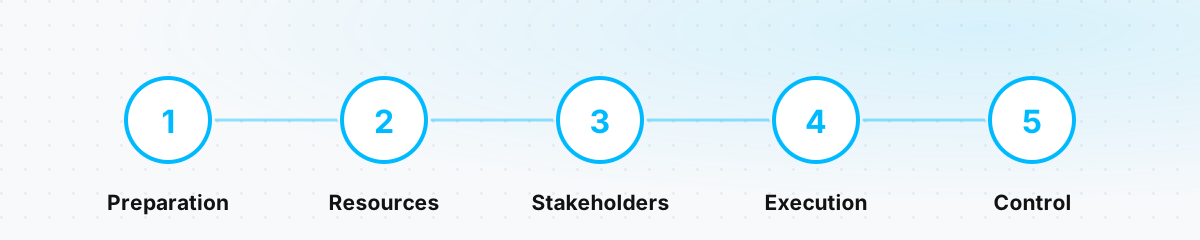
Preparation: Identifying Requirements, Resources, and Stakeholders
The quality of the preparation determines the quality of the implementation. A comprehensive resource analysis is the starting point for successful coordination. Anyone who cuts corners in this phase pays for it later with delays and rework.
Capturing Requirements Precisely
Before you begin coordinating, all requirements must be fully documented. This sounds obvious, but is often underestimated in practice. Requirements change, get added retroactively, or remain vaguely formulated. This leads to misunderstandings between departments and suppliers.
Use the following checklist to capture requirements systematically:
- Goal and benefit: Record which problem the project result solves and what the client will measure success against, before you start collecting individual requirements.
- Functional requirements: Describe what the plant, the assembly, or the system has to deliver, and do so from the perspective of later operation rather than from the perspective of the solution already envisaged.
- Technical constraints and interfaces: Capture performance data, availabilities, and environmental conditions, as well as all transitions to existing plants, supplied parts, and IT systems.
- Standards, regulations, and evidence: Document the applicable rules, approvals, and test certificates, together with the question of who provides them; in regulated industrial environments this determines the acceptance date.
- Explicit scope exclusions: Note just as clearly what is not part of the contract, because unwritten expectations are one of the most common causes of later claims for additional work.
- Verifiable acceptance criteria: Every requirement needs a criterion against which it can be objectively checked whether it has been met; ISO/IEC/IEEE 29148 requires exactly this verifiability as a quality characteristic of a requirement.
Capturing Resource Needs and Availability
A common mistake in preparation is assuming that resources are available without actually verifying it. Especially in industrial environments, where employees are often working on multiple projects in parallel, bottlenecks quickly arise here.
The following comparison model shows how different resource planning looks without and with systematic support:
| Aspect | Without Systematic Resource Management | With Digital Resource Management |
|---|---|---|
| Capacity overview | Manual, often outdated | Real-time, automatically updated |
| Conflict detection | Reactive, after problems occur | Proactive, before bottlenecks occur |
| Planning effort | High, error-prone | Reduced, data-based |
| Transparency for executives | Low | High, at the portfolio level |
| Responsiveness to changes | Slow | Fast, scenario-based |
Effective resource management means not only capturing capacities, but also playing through scenarios: What happens if a key employee is unavailable? Which projects fall behind if a machine needs unplanned maintenance?
Involving Stakeholders Early
Stakeholders — that is, all people and groups who have an interest in the project outcome or are affected by it — must be identified and involved early on. This is especially true for supplier integration, which is often underestimated in industry.
The following steps help with structured stakeholder management:
- Identify completely: Capture internal and external parties alike, meaning specialist departments, purchasing, production, the works council, the client, suppliers, and, for projects requiring permits, the authorities as well.
- Assess influence and interest: Classify every stakeholder by their influence on the project and their interest in the result; the influence-interest matrix is the customary tool for this in the practice of PMI and GPM.
- Gather expectations and concerns: Actively ask what the most important groups expect from the project and what they fear, instead of deriving it from their role.
- Define the involvement for each group: Determine who receives which information and when, and who has a say in which decisions; for suppliers, binding response deadlines and defined interfaces are a mandatory part of this.
- Readjust regularly: Check at the milestones whether influence, interest, or attitude have shifted, and adapt the involvement accordingly.
Pro tip: Hold a structured kick-off workshop at the start of the project in which all stakeholders can openly communicate their expectations and concerns. Experience shows that this investment of a few hours saves weeks of rework and misunderstandings later in the project.
Implementation: Step-by-Step Toward Strong Coordination
Once all prerequisites are in place, the actual coordination work begins. This is where it becomes clear whether the careful preparation pays off or whether gaps in implementation jeopardize the project’s success.
Defining Task Allocation and Responsibilities
The first step in the implementation phase is structured task allocation. Every task gets exactly one owner, a clear goal, and a defined completion date. Tasks without an owner do not get done. This is not theory — it is an experience that keeps getting confirmed in industrial practice.
Proceed as follows:
- Cut work packages cleanly: Break the project down far enough that each work package, in the sense of DIN 69901, is the smallest unit of the work breakdown structure that is not subdivided further and delivers a clearly delimited result.
- Name the deputy and the escalation path: For each work package, define who takes over during an absence and who is notified on delay — a RACI matrix additionally separates those who execute from those who decide and those who merely need to be informed.
- Describe the result, not the activity: Formulate what has to exist at the end and how completion will be recognized, not what the owner should occupy themselves with.
- Check effort against real availability: Reconcile the estimated effort with the person's actual capacity, including their commitments in other projects, before you fix the date.
- Document the assignment bindingly: Record the owner, the result, the deadline, and the dependencies in a place everyone can see, so that commitments do not disappear into meeting minutes and inboxes.
Digital task tracking makes this process considerably more efficient. Task tracking and clear responsibilities increase traceability and reduce duplicate work steps. In practice, this means less email chaos, fewer status meetings, and more time for productive work.
Communication and Documentation During the Project
Good coordination thrives on good communication. This does not mean that more needs to be communicated, but rather that communication needs to be more targeted. The following communication moments are essential in every industrial project:
- Kick-off: At the start of the project, the reporting paths are agreed: who reports on what, to whom, at which cadence, and through which channel. If that is left open, the flow of information later takes shape by chance, out of the habits of individual participants.
- Regular project team meeting: A fixed, short standing meeting with a consistent agenda keeps the comparison between plan and reality going, without generating additional coordination rounds.
- Status report to the client and the steering committee: At a fixed cadence and in a uniform format, project management reports on progress, risks, and milestones, so that decisions are made on the same basis.
- Milestone and approval dates: Before every phase transition, it is checked and confirmed in writing whether the agreed results are in place; a milestone involves more than a date, namely the specified scope of work and its interfaces.
- Interface alignment with suppliers: External partners need their own coordination points with clear response deadlines, because otherwise progress and delays on their side only become visible on delivery.
- Escalation: When a deviation exceeds the agreed threshold, the decision-making level is addressed immediately and directly, instead of leaving the information to sit until the next status report.
Documentation is not bureaucratic busywork for its own sake. It creates traceability, protects everyone involved, and forms the basis for later improvements. Use central repositories that are accessible to all project participants.
Prioritization, Deadlines, and Handling Changes
Every project involves changes. New requirements, technical problems, delivery delays, or staffing bottlenecks are not exceptions — they are the norm. What matters is how the project team handles them.
The following measures help manage changes in a structured way:
- A uniform change request: Every change is recorded in writing, with the requester, the affected work package, the justification, and the desired date; a remark in passing is not a change request.
- Impact analysis before the commitment: Before every decision, assess the consequences for schedules, costs, capacities, quality, and dependent work packages, so that the price of a change is visible beforehand and does not surface later in the course of the project.
- A defined decision-making authority: Govern who may decide on their own up to which level of impact and from when on a change control board decides; DIN 69901-5 describes change management precisely as capturing, assessing, deciding on, documenting, and controlling the implementation of changes.
- An updated planning baseline: After approval, the plan is updated and the new version marked as the valid baseline; otherwise you keep comparing progress against an outdated target state.
- Controlled communication of the decision: Everyone affected, explicitly including suppliers and neighboring projects, receives the decision and the new dates that follow from it, not just the requester.
Pro tip: Hold short daily or weekly stand-up meetings of no more than 15 minutes, in which each team member answers three questions: What have I accomplished since the last meeting? What am I planning next? Are there any obstacles? This routine creates transparency and resolves small problems before they become big ones.
Control, Optimization, and Lessons Learned
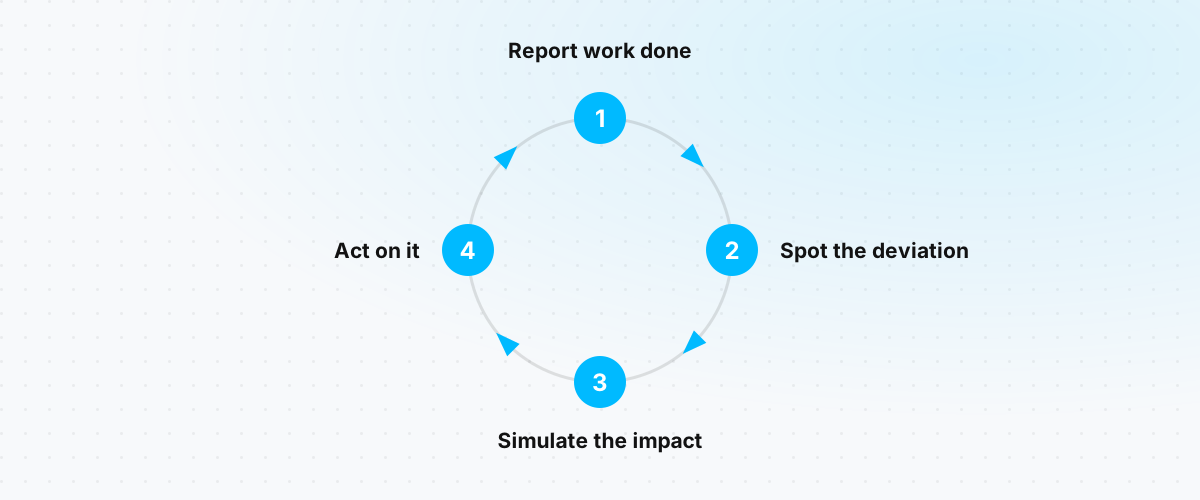
After implementation comes securing lasting success through follow-up and targeted optimization. In practice, this step is often neglected because the next project is already waiting. That is a mistake that proves costly in the long run.
Effective Project Closure and Review
A structured project closure meeting is more than a formality. It is an opportunity to learn from the completed project and make that knowledge usable for future projects. Regular project reviews and feedback help identify weaknesses early and address them systematically.
An effective closure meeting follows this structure:
- Plan-versus-actual comparison against the last valid plan: Compare schedules, costs, scope of work, and quality with what was last agreed as binding.
- Open items and remaining work: Record what is still outstanding, each with an owner, a deadline, and a priority, so that nothing passes unnoticed into operation.
- Formal acceptance and handover: The client confirms that the acceptance criteria have been met, and the result is handed over with complete documentation to operations, maintenance, or service.
- Review of the process and the collaboration: Collect what helped and what got in the way, consistently focused on the issues rather than on individuals, because otherwise nobody will report openly next time.
- Root cause analysis of the largest deviations: Trace the most serious deviations back to their root cause, instead of treating every single observation in equal detail.
- Derive and document measures: Every insight gets a concrete measure with an owner and a deadline and is filed in a central place that can be found for upcoming projects.
Measures for Process Improvement
Process improvement is not a one-time event, but a continuous cycle. Every completed project provides data and insights that should feed into the next round of planning.
Proven measures for systematic process improvement:
- Run improvements in the PDCA cycle: Plan, implement, check the effect, secure it; without the check step, the insights from the closure meeting remain declarations of intent.
- A few cross-project metrics: Collect figures such as schedule adherence, effort variance, or the number of approved changes across all projects using the same definition; otherwise projects cannot be compared and patterns cannot be recognized.
- Transfer improvements into the standard: What has proven itself belongs in binding templates for the work breakdown structure, the status report, the change request, and the acceptance protocol, because securing gains through adapted standards is the core of every continuous improvement process.
- A named process ownership: Without a role, a project office for example, that maintains the standards and insists on their application, templates disintegrate into individual variants again over time.
- Develop improvements together with the people who do the work: Whoever applies a template or a workflow every day sees the weak spot first; a continuous improvement process depends on those affected helping to shape the change rather than merely hearing about it.
Establishing Feedback and Knowledge Sharing
“An organization’s most valuable asset is not its technology or its budget, but the accumulated experiential knowledge of its project teams. Systematically capturing and sharing this knowledge is one of the most important leadership tasks in project management.”
Knowledge sharing means that insights from individual projects do not remain solely in the heads of individual employees, but are documented and shared in a structured way. This can happen through internal wikis, project databases, or regular knowledge-sharing meetings. What matters is that sharing knowledge is part of the corporate culture and is actively encouraged.
Multi-project management at the portfolio level makes it possible to apply insights from individual projects across the board and to identify patterns that are not visible at the project level. Anyone managing multiple projects simultaneously benefits especially from a central data foundation that enables comparisons and forecasts.
Why Common Project Coordination Myths Are Dangerous in Industry
In our work with industrial companies, we repeatedly encounter the same convictions that sound plausible at first glance but lead to significant problems in practice. Three of them are especially widespread and especially dangerous.
Myth 1: More Control Leads to Better Results
Many project managers respond to uncertainty with more control: more reports, more meetings, more approval loops. The result is often the opposite of what was intended: the team slows down, decisions take longer, and motivation declines.
Control is important, but it has to be targeted. Monitor results and deviations, not every single work step. Give your team the framework and the trust to act on their own responsibility within that framework. This requires that goals are clearly defined and that deviations become visible quickly — through good tools, not through more meetings.
Myth 2: A Good Plan Makes Flexibility Unnecessary
No plan fully survives first contact with reality. Industrial projects are complex, and complexity means unpredictability. Anyone who rigidly sticks to a plan even after the underlying conditions have changed risks arriving at a goal that nobody needs anymore.
Flexible process models make it possible to respond to changes without losing the overview. This does not mean proceeding without a plan, but rather treating the plan as a living document that is reviewed and adjusted regularly. Small, iterative correction loops are more effective than major plan revisions every three months.
Myth 3: Mistakes Must Be Avoided and Those Responsible Named
A culture in which mistakes are punished is a culture in which mistakes are hidden. This is especially dangerous for industrial projects, because problems then only escalate once they are barely solvable anymore.
Transparency through an open error culture does not mean tolerating mistakes, but making them visible early and solving them together. When a team member reports a problem before it escalates, that is an achievement, not a weakness. Leaders who model this create teams that act proactively rather than reactively. That is the decisive difference between projects that succeed despite problems and those that fail because of problems that had been known for a long time.
Modern Tools for Efficient Project Coordination
The steps described in this article can be implemented considerably more efficiently with the right digital tools. Manual processes, spreadsheets, and email communication quickly reach their limits in complex industrial projects.
Linetrack offers you an integrated platform specifically developed for the requirements of industrial project teams. With project planning in Linetrack, you automate scheduling and get an up-to-date overview of project status at all times. The integrated task tracking makes tasks, responsibilities, and progress transparent for everyone involved, without information loss from manual hand-offs. Linetrack’s resource management lets you plan capacities realistically, identify bottlenecks early, and play through scenarios before decisions are made. Book a demo now and experience how Linetrack takes your project coordination to the next level.
FAQ
Frequently Asked Questions About Project Coordination
Coordinate Projects with Confidence — with Linetrack
Experience in a 30-minute live demo how Linetrack simplifies project coordination in your industrial company: tasks, responsibilities, schedules, and status overview in one integrated platform.