Orientation
Supplier management
inside the project

In short
Supplier management covers everything from selecting and qualifying suppliers to contracts, ordering, evaluation, risk and schedule coordination. The first five areas belong in SRM and procurement systems. Linetrack covers only the sixth: coordinating external partners' dates and deliverables inside the running project – subcontracts, onboarding and status feedback in the same plan as internal departments.
Definition
What does supplier management actually cover?
Supplier management consists of six task areas: supplier selection and qualification, contracts and terms, order processing, supplier evaluation, risk and compliance management, and coordinating dates and deliverables in a running project. The first five are procurement and SRM tasks with systems of their own. The sixth arises only once the project runs – usually handled by email and phone.
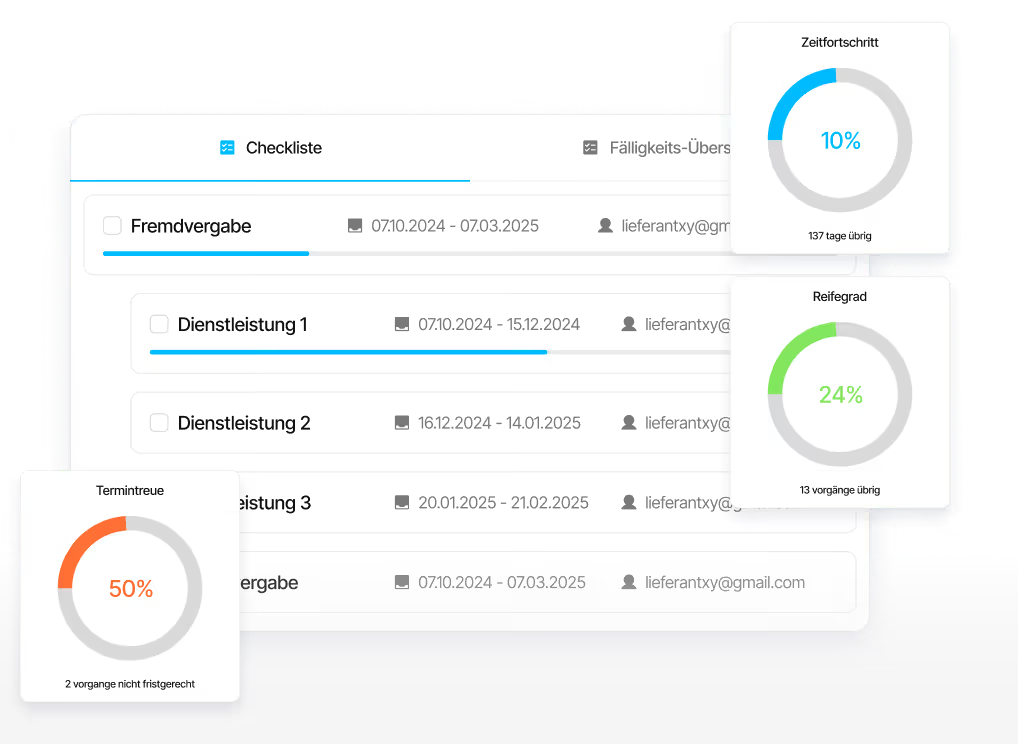
Linetrack covers point 6 – and only point 6. Points 1 to 5 are SRM and procurement tasks; there are established systems for them, and Linetrack is not one of them. Linetrack answers the question that only arises after the award: will the date this supplier committed to for this project hold – and will we notice in time if it does not? How that works in practice is described in the supplier integration use case; the features behind it are on the supplier access product page.
Scope boundary
What an SRM system does – and what Linetrack does
Supplier selection, evaluation, risk management and purchasing processes have a well-served market of their own: SupplyOn, JAGGAER, Onventis and Simmeth are established across German-speaking industry and model these processes far more deeply than any project software ever would. Linetrack does not compete with them and does not replace them. Linetrack answers a different question: not „which supplier do we work with?“, but „will the date this supplier committed to for this project hold?“.
The dividing line is not a marketing question but a data question: an SRM system knows suppliers and orders, but not the schedule the subcontract hangs in. A project system knows the schedule, but not the sourcing decision. That is why point 6 falls between the two systems in many companies and ends up being chased by email and phone. How expensive that gap is already shows internally: in 59% of live Linetrack implementations, „manual status chasing“ was among the initial pain points (multiple answers possible). Across a company boundary the same mechanism only gets slower, because the supplier has no access to the plan whose date they are meant to hold. At Linetrack the subcontract therefore runs through the same plan as internal capacity, which multi-project management already tracks across every project – in machinery and plant engineering this is the norm, because subcontracts there sit directly in front of assembly and commissioning dates.
*Figures from a full survey of all live Linetrack implementations, as of August 2026. Multiple answers possible.
Where to go next
Where your question belongs
If you are looking for a system that selects suppliers, rates them and processes purchase orders, this page is a dead end – you need an SRM or procurement system, not a project tool. If your question is instead how an outsourced control cabinet build, an external assembly crew or a bought-in controller sits in your project schedule, you are in the right place: the supplier integration use case describes how subcontracts become sub-projects in the schedule and how suppliers report progress back themselves.
The feature level behind it – onboarding via an automatic invitation, a free collaboration license for the supplier, a separate compliance-ready project area – is on the supplier access product page. If you would rather not create subcontracts by hand, integrations shows how they are generated automatically from the ERP as sub-projects in the plan. Everything else – selection, contract, order, evaluation, risk – stays where it belongs: in procurement.
Read on
Two pages that actually answer it
This page exists to sort the question out, not to rank against the SRM vendors. The real answers are on the two pages behind it.
Use case: supplier integration
How subcontracts enter the schedule as sub-projects, how suppliers report progress and files back themselves, and how a delay becomes visible before it hits the assembly date.


Product: supplier integration
The features behind it: subcontract as a sub-project with defined deliverables, automated onboarding, a free collaboration license and a separate, compliance-ready project area.
FAQ
Frequently asked questions
Still have questions?
Book a meeting with our team.
What does supplier management actually cover?
What does supplier management actually cover?
What is the difference between supplier management and supplier relationship management?
What is the difference between supplier management and supplier relationship management?
Do you need dedicated supplier management software?
Do you need dedicated supplier management software?
Does Linetrack replace SupplyOn, JAGGAER or Onventis?
Does Linetrack replace SupplyOn, JAGGAER or Onventis?
How are external suppliers brought into project planning?
How are external suppliers brought into project planning?
Which companies benefit from supplier management inside the project?
Which companies benefit from supplier management inside the project?
Learn more
Linetrack in detail
The features behind coordinating dates and deliverables with suppliers: